
Fast responses don’t guarantee conversions if the first interaction doesn’t actually start a conversation. This piece explores why engagement velocity—how quickly a lead replies—is becoming a stronger revenue predictor than raw response time, and how AI-driven follow-up changes the equation.
TL;DR
- The winner in 2026 is the one who starts a two-way exchange fastest, speed to lead vs speed to conversation is the deciding factor.
- Track the right numbers: lead engagement metrics that center on response and reply rates tell you what’s working.
- AI lead engagement closes the gap between first touch and first reply by being instant, persistent, and relevant at scale.
- Treat every minute like money: lead response optimization improves contact rates, conversions, and pipeline velocity.
- Build a dependable system for lead follow up so no prospect slips through the cracks, even when your team is busy.
Why is 2026 the turning point for sales responsiveness?
Because buyers do more homework, expect instant answers, and often decide before a rep ever speaks to them. Today, most leads never talk to sales, only about 27% ever reach a real conversation, and 80% of cold calls go to voicemail while half of reps stop after one attempt. Those numbers are drawn from aggregated sales data and analysis of outreach behavior over thousands of attempts (LinkedIn analysis). If you want different outcomes in 2026, the strategy must evolve from “who called first” to “who got a reply first.” That’s the core of speed to lead vs speed to conversation: being first to dialogue, not just first to dial.
At the same time, response expectations are collapsing. Over 50% of people expect a brand to respond in under an hour, and nearly three out of four will switch after one bad experience (customer support response stats). That’s not just support, it shapes buyer tolerance everywhere. Add in B2B reality: in roughly 84% of deals, the buying group has effectively chosen a vendor before they engage with sales (6sense research). If you’re measuring the wrong thing, you’ll move fast, and still come in second. To win, teams need lead engagement metrics that illuminate how quickly you earn replies and how often those replies convert.
Why does speed-to-conversation beat speed-to-lead now?
Because speed-to-lead without a response is noise. The first one to get a “yes,” a text back, or a calendar click wins, so speed to lead vs speed to conversation is not a tie in 2026, it’s a landslide for conversation. Responding in under five minutes can make a lead roughly 21× more likely to convert, but only if the contact actually turns into a reply (analysis of timing and conversion).
A fast missed call, an unread email, or a single voicemail isn’t momentum, it’s a lull. The shift is from being first to contact to being first to dialogue. Given that 27% of companies never respond to new leads at all and under 30% get back within five minutes (law firm response study), there’s tremendous room to win by starting the conversation reliably. That’s the practical meaning of lead response optimization: combining fast first touch with predictable steps that secure a reply.
How fast is fast enough to earn a reply?
Within five minutes is still gold. Under five minutes can dramatically lift conversion likelihood, and responding within 24 hours (versus later) boosts engagement by ~22% and closes ~60% more deals (timing data). But the real unlock is pairing speed with consistency and relevance, classic lead response optimization. Back-to-back attempts across channels within an hour, then steady nudges for several days, dramatically increase your shot at a reply.
** Here’s the rub:**most sales are won after five to twelve touches, yet many teams stop after one or two, especially with lead follow up when the calendar gets crowded (outreach persistence insight). That’s exactly where AI lead engagement shines, sustaining momentum until a real exchange begins.
How should you measure success differently in 2026?
Prioritize reply velocity and engagement. The easiest way to switch your operating system is to elevate lead engagement metrics above vanity stats like “dials” or “emails sent.” Make the main goal the time from sign-up to first reply and the rate at which leads actually respond. Then layer in lead engagement metrics that reveal bottlenecks. Track contact rate (unique two-way contacts), qualification rate, meeting-set rate, and reply-time distribution by channel and segment. If those numbers stagnate even while you’re faster on first touch, you’ve learned that speed alone doesn’t fix message–market mismatch.
Just as important, benchmark speed to lead vs speed to conversation to see where the real drag lives. If you get to leads in minutes, but replies take days, focus on message, channel mix, and sequencing. This is the heart of ongoing lead response optimization and a smart roadmap for lead follow up.
What KPIs and dashboards actually move revenue?
- Time to first reply (median and 90th percentile)
- Conversation rate by source and channel
- Contact rate and qualification rate by persona
- No-response ratio after X touches
- Channel lift: SMS vs email vs voice vs social
- Meeting-set within 24 hours of first reply
Pair these with lead response optimization tests. A very fast response time with low contact/qualification rates means your scripts, value props, or channels aren’t resonating (operations guidance). Keep the board updated weekly and tie targets to revenue, not just activity. If you use LeadChaser, you can centralize these lead engagement metrics alongside booking and routing on theLeadChaser homepageor dig deeper into analytics on theLeadChaser Featurespage.
Quick reference: metrics that matter
MetricWhy it mattersAction if laggingTime to first replyCore of speed to lead vs speed to conversationShorten first-touch delay; add SMSConversation rateMeasures whether messages spark dialogueTest openers; shift channel mixQualification rateSignals message–market fitRefine persona-specific scriptsNo-response ratioFinds where lead follow up stallsExtend sequence; add AI lead engagement
How can AI help you spark real conversations at scale?
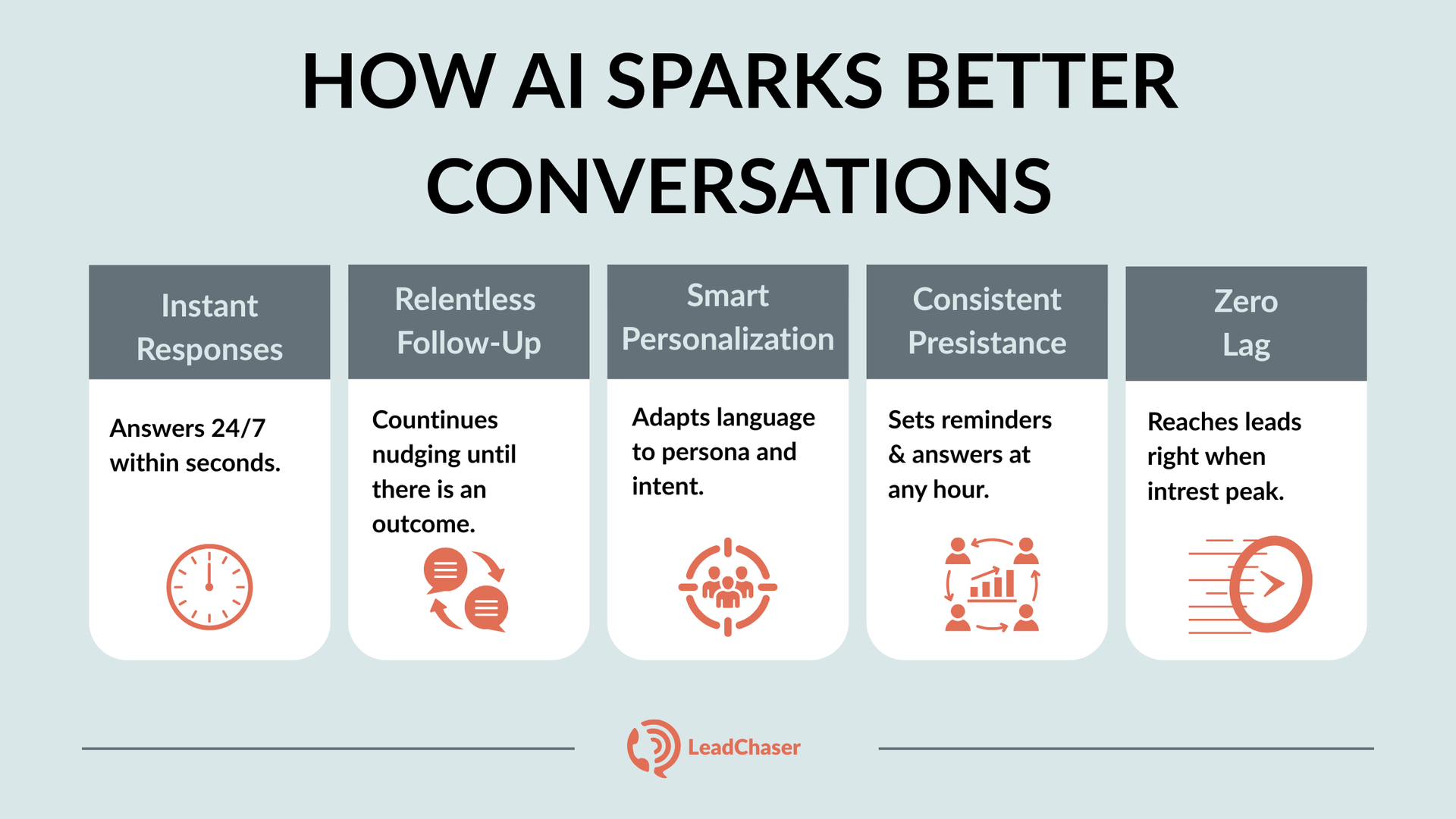
By being instant, tireless, and personal. AI lead engagement answers in seconds, follows up relentlessly, and adapts tone or content by persona and intent, all without adding headcount. Automated AI SMS and email sequences regularly deliver 250% higher response rates than manual efforts thanks to optimal timing and consistent persistence (AI sequencing ROI). The outcome is better lead response optimization with less manual lift and more time for reps to handle qualified conversations.
Just as powerful, AI lead engagement removes human variability. Every qualified inquiry hears from you right away (even at 2 a.m.), and every lead follow up continues on schedule, across channels, until you’ve either earned a reply or disqualified the prospect. That frees reps to focus on real conversations and proposals, not chasing down missed callbacks or formatting one-off emails. Persistently nudging people without sounding robotic is the magic. Modern systems can reference what a lead downloaded, answer basic questions, propose times that match your calendar, and hand off seamlessly when a human is needed, the practical definition of lead response optimization.
If you’re building this now, consider a platform designed for conversations first. LeadChaser focuses on getting prospects to reply, fast, with intelligent routing, SMS-first playbooks, and native scheduling. Explore theLeadChaser Features, compare plans on theLeadChaser Pricingpage to see how AI lead engagement fits your motion.
What does a modern, conversational playbook look like?
Here’s a field-tested baseline you can adapt, aimed squarely at winning the speed to lead vs speed to conversation race.
1. Minute 0–2: Immediate SMS + email SMS: “Saw your request for a demo of [benefit]. Two quick options, want a short video now or a 10‑min live walkthrough? I can also text answers.” Email: Short, helpful, includes 2–3 self-serve resources and a one-click calendar link. If AI lead engagement is enabled, it proposes times and answers basic FAQs on the spot.
2. Minutes 10–30: Follow-up ping A second, value-adding touch: a 60-second video answering the most common question for that form. This is frictionless lead follow up.
3. Hour 1: Call attempt + voicemail + SMS Call once; leave a 20-second, benefit-led voicemail. Immediately text a summary and a link to pick times.
4. Hours 4–24: Multi-channel sequence Email with “good-better-best” paths (quick video, chat now, book time). SMS with one crisp question to invite a reply. If no response, your AI lead engagement agent continues the thread the next morning with relevant specifics.
5. Days 2–7: Persistent, patient nudges Rotate channels. Keep messages short. Reference something specific they did (downloaded a guide, clicked pricing). Build in a helpful opt-out and a “save me for later” path.
Which channels convert best (and when)?
Use SMS to start; layer email and voice to deepen context. SMS has ~98% open rates and around 35% reply rates (channel benchmarks). That makes it the most reliable short path to a first reply and a linchpin of lead response optimization.
Email carries the detail; voice adds trust when used selectively. Social DMs can be effective for certain personas. If one channel stalls, the others pick up the slack, exactly how AI lead engagement sequences earn more conversations. Your lead engagement metrics will quickly show which mix drives the best reply velocity, which in turn reduces the gap in speed to lead vs speed to conversation.
What should the first 24 hours look like?
- Hour 0: Instant SMS + email (value forward)
- Hour 1: Call + voicemail + SMS recap
- Hours 4–6: Short email with a credible “why now”
- Hour 24: Check-in SMS guided by your best-performing scripts
Across this window, you’re optimizing both contact rate and reply velocity. The goal is not just speed, it’s proving helpfulness quickly. That’s how speed to lead vs speed to conversation tilts your way: you’ve asked a simple question, offered clear options, and made it easy to answer. As your lead engagement metrics improve, double down on the best-performing steps.
What tools and platforms should you consider in 2026?
Look for systems that put conversations at the center. The Best platforms for quick customer response management are built for instant replies, intelligent routing, and native scheduling. Ask:
- Can you launch AI lead engagement on SMS, email, and chat in minutes?
- Are sequences adaptive by persona and source?
- Do you get built-in analytics for lead engagement metrics and reply velocity?
- Does it support true lead response optimization with A/B tests across time-of-day, channel, and message?
- Is calendar booking embedded in the thread?
LeadChaser is purpose-built around these principles: SMS-first, automation that feels human, and analytics you can act on. Explore our approach on theLeadChaser homepage, and for practical playbooks, theLeadChaser Blogshares tests and templates that accelerate replies, useful for any stack that aims to be among the best platforms for quick customer response management.
A quick comparison to guide selection
CapabilityWhy it mattersWhat to verifyTwo-way SMS + emailSparks replies faster than voice aloneNative routing, compliance, templatesCalendar in-threadEliminates scheduling frictionOne-click booking from SMS/emailAI lead engagementInstant replies and adaptive follow-upsPersonalization by persona/sourceLead engagement metricsVisibility into reply velocitySegment-level dashboards and testing
How do you roll this out in 30 days?
You can stand up a “conversation-first” engine in four weeks with these phases. This plan bakes in lead response optimization and ensures tight lead follow up from day one.
Week 1: Baseline and blueprint
- Audit time-to-first-reply and conversation rate by channel.
- Map the top five objections and five common questions.
- Define success thresholds for your lead engagement metrics (e.g., 40% of replies within 2 hours for inbound demo leads).
- Choose a platform that supports AI lead engagement and native scheduling.
Week 2: Craft messages and sequences
- Write SMS, email, and voicemail scripts that deliver value in the first sentence.
- Build a 7-day sequence with 5–8 touches.
- Configure routing and calendar integration for lead response optimization.
Week 3: Launch and coach
- Turn on the sequences for one lead source.
- Coach reps to respond to AI-qualified replies in seconds.
- Create a same-day review ritual to refine scripts and timing based on lead engagement metrics.
Week 4: Expand and A/B test
- Roll out to more sources.
- Test two subject lines, two SMS openers, two call windows.
- Report weekly on conversation rate, reply-time distribution, and no-response ratios—and adjust lead follow up accordingly.
Document your tests so wins scale quickly. The sooner your team thinks in conversations (not just contacts), the faster you’ll feel the compounding effects. This is the essence of mastering speed to lead vs speed to conversation while building durable habits around lead response optimization.
What results should you expect?
Faster replies, higher conversion, and cleaner pipeline. Teams that scale conversation-first programs often see rapid lifts in contact and meeting rates. In one analysis, automating neglected sequences produced a 47% conversion increase in a B2B motion, not by finding more leads, but by actually reaching the ones they already had(conversion impact case). Pair that with the fact that buyers expect rapid replies (expectations data) and that many competitors still respond late or not at all (response time study), and you can see the path to outsized gains.
Two closing tips that we see work across segments:
- Keep speed to lead vs speed to conversation visible on your dashboards; it clarifies where to focus work.
- Make AI lead engagement a multiplier for your team, let automation handle the timing and nudges while your humans handle nuance and trust.
FAQ
Q1) How do I choose tools for speeding up customer conversations?
Prioritize platforms that make it effortless to start and sustain threads on SMS and email without losing context. You want instant replies, one-click booking, and analytics that feed your lead engagement metrics. Bonus points if AI lead engagement can answer FAQs, propose times, and hand off seamlessly to humans. Test with a small lead source, compare reply velocity in week one, then expand. LeadChaser bundles these tools for speeding up customer conversations with routing and scheduling so you can move quickly from pilot to scale.
Q2) What are the Best platforms for quick customer response management?
Look for systems that natively support two-way SMS, intelligent routing, and calendar booking in-thread. Evaluate whether they enable structured experiments for lead response optimization, time-of-day, channel mix, and messaging, and whether reporting is granular enough to guide action. Among the best platforms for quick customer response management, the difference-maker is how fast you can reduce the gap in speed to lead vs speed to conversation.
Q3) How do I set lead engagement metrics that actually predict revenue?
Start with time to first reply, conversation rate by source, and meeting-set within 24 hours of first reply. Then add qualification rate and no-response ratio after a defined number of touches. Calibrate targets by segment, enterprise and SMB behave differently. As you collect data, your AI lead engagement system can also surface patterns that tell you which segments need different cadences. Well-chosen lead engagement metrics help you operationalize lead response optimization and improve lead follow up where it matters most.
Q4) What’s the ideal cadence for lead follow up in the first week?
Aim for 5–8 touches over 7 days, starting with instant SMS and email, then layering a call plus SMS within the first hour. Keep messages short and helpful, rotate channels, and anchor each touch to a micro‑call‑to‑action (a question, a link, or a single choice). By day two or three, if there’s no response, your AI lead engagement sequence should adapt tone and timing, then gracefully pause with a “check back next quarter?” option. This cadence balances lead follow up persistence with respect for the buyer’s time, key to winning speed to lead vs speed to conversation.
Q5) Is there still a place for speed-to-lead, or should we replace it entirely?
Keep it, but make it the opening act. You still want to contact leads quickly, yet the strategic target is a reply. Treat speed-to-lead as the trigger that starts your conversational engine. The primary scoreboard is speed to lead vs speed to conversation; when you push that gap down and increase first-reply rates, you’ll see meeting volumes and win rates rise. Your lead engagement metrics will prove it, and your lead response optimization program will lock it in.
Q6) Where do solutions for rapid lead engagement fit in a modern stack?
Solutions for rapid lead engagement sit between your demand sources and your CRM, orchestrating the instant touch, the persistent follow-ups, and the clean handoff to a human. In practice, they combine AI lead engagement, SMS-first sequences, routing, and lead engagement metrics that spotlight reply velocity. When implemented well, these solutions for rapid lead engagement compress the time from form-fill to qualified conversation and standardize high-quality lead follow up across every channel. LeadChaser was built specifically as one of those solutions for rapid lead engagement.
The bottom line
In 2026, getting there first is only half the race. Getting a response wins it. When you center your operating model on conversation speed and quality, measured with clear lead engagement metrics, powered by AI lead engagement, tuned through ongoing lead response optimization, and enforced with rigorous lead follow up, you stop losing deals in silence. That’s the practical edge in speed to lead vs speed to conversation: being the one who earns the reply, not just the one who makes the first ping.
If you’re ready to put this into practice, see how a conversation-first stack can work for your team. Explore the approach on theLeadChaser homepage, and skim recent best practices on theLeadChaser Blog.
Works Cited
- 6sense. “Moving on from Lead-Centricity.” 6sense, n.d.,https://6sense.com/science-of-b2b/moving-on-from-lead-centricity/.
- Hennessey Digital. “2024 Law Firm Lead Form Response Time Study.” Hennessey Digital, 2024,https://hennessey.com/2024-law-firm-lead-form-response-time-study/.
- LeadHero. “AI SMS and Email Follow-Up ROI Breakdown.” LeadHero, n.d.,https://leadhero.ai/ai-sms-and-email-follow-up-roi-breakdown/.
- LiveChatAI. “Customer Support Response Time Statistics.” LiveChatAI, n.d.,https://livechatai.com/blog/customer-support-response-time-statistics.
- Teamgate. “Lead Response Time Study: Speed Impacts Revenue.” Teamgate Blog, n.d.,https://www.teamgate.com/blog/lead-response-time-study-speed-impacts-revenue/.
- Woolston, John C. “What if I told you 73% of your leads never talk to a rep...”—LinkedIn Post. LinkedIn, n.d.,https://www.linkedin.com/posts/johncwoolston_what-if-i-told-you-73-of-your-leads-never-activity-7401411336121040896-cVUA.