
Most teams talk about “speed to lead,” but very few design the actual experience inside the first five minutes. This article outlines a structured framework for what should happen between form submission and the first conversation, across calls, SMS, routing, and qualification, to maximize revenue impact.
TL;DR
- More than 99% of B2B companies fail to respond to a lead within 5 minutes, according to a2025 Workato study of 114 companies.
- Enabling instant scheduling after form submission can increase booked-meeting conversion from approximately 30% to 66.7%, according toChili Piper's analysis of ~4 million form submissions.
- In aRevenueHero study of 1,000 B2B demo request flows, 635 sites never responded at all, and the average response time among those that did was 1 day, 5 hours, and 17 minutes.
- Salesforce's 2026 State of Sales reportconfirms 87% of sales organizations now use AI in sales, yetGartner warnsthat fewer than 40% of sellers will report that AI agents improved productivity by 2028 without deliberate orchestration.
- SMS has a 98% open rate, but the FTC recorded$470 million in losses from text-based scams in 2024, meaning that fast, unbranded outreach is now a liability, not an asset.
Why Does the "Golden Conversion Window" Actually Start the Moment a Form Is Submitted?
The golden conversion window begins at the exact millisecond a prospect clicks submit, not when a sales rep notices a CRM notification. That five-minute period is when buyer intent is highest, cognitive engagement is sharpest, and the probability of converting a form fill into a booked conversation is statistically at its peak.
The problem is not a lack of awareness about response time. Most revenue leaders have seen some version of the data: respond faster, close more deals. The real gap is that almost no one has deliberately engineered what actually happens inside those five minutes. There is no designed sequence, no channel logic, no qualification gate, and no trust architecture. There is just the hope that someone on the team will notice the notification and act.
That is not a strategy. It is a prayer. And the data confirms it is failing at an extraordinary scale.
According to the2025 Workato mystery-shopping study, which tested 114 B2B companies, more than 99% did not respond to a lead submission within five minutes. Not 50%. Not 30%. More than 99%. Only one company sent a personalized email within five minutes, and the average response time to deliver a personalized email across the full sample was 11 hours and 54 minutes. Phone outreach was even worse: 31% of companies attempted a call, and the average response time by phone was 14 hours and 29 minutes. Not a single company called within five minutes.
This is the competitive landscape your organization is operating in. The bar is extraordinarily low, which means the upside of engineering this window is correspondingly massive. Effective lead management in this window can transform how lead generation strategies perform, ensuring that sales leads are not lost due to slow response time.
What Does the Research Actually Say About How Buyers Behave Inside This Window?
Buyers in this window are not sitting still and waiting. They are online, switching tabs, texting, and evaluating at least one other vendor. The patience for ambiguity has dropped to near zero.
Pew Research data publishedon January 8, 2026, from a survey fielded from February through June 2025, reports that 41% of U.S. adults are online almost constantly, including 63% of adults ages 18 to 29. The moment a buyer submits a form without receiving a meaningful response, the window begins to close. The next tab they open may be your competitor.
This is precisely why lead management decisions made inside five minutes carry disproportionate revenue weight. Strong lead management is not about following up at some point in the workday. It is about designing a sequence that acknowledges, qualifies, routes, engages, and converts before the buyer's attention has moved elsewhere.
The current industry reality, as documented in RevenueHero's study of 1,000 B2B websites, is that 635 of 1,000 sites did not respond at all to a demo request. Among those who responded, the average response time was 1 day, 5 hours, and 17 minutes. RevenueHero also noted that companies using enrichment tools to silently disqualify sales leads never communicated the disqualification to the prospect. Every single non-responder failed to close the loop, creating a broken experience for a buyer with genuine intent.
Effective lead management in 2025 and beyond is not just about speed. It is about creating certainty: a designed sequence in which the buyer always knows who is contacting them, when, through which channel, and what the next step is. Implementing AI in sales can further enhance lead management by automating initial responses and ensuring that sales leads are engaged promptly.
Why Are Most Lead Generation Strategies Failing at the Response Layer?
Most lead generation strategies are built to fill the top of the funnel and then rely on manual effort to convert at the bottom. The architecture is asymmetric: significant investment in driving traffic, ads, content, and SEO, with almost no investment in systems for what happens in the three to five minutes after a form is filled.
The consequences are measurable and costly. Chili Piper's analysis of approximately 4 million form submissions found that letting qualified prospects book immediately after submission lifts booked-meeting conversion from approximately 30% under manual follow-up to 66.7% when scheduling is embedded in the flow. That is more than double. It is not a marginal optimization. It is a structural redesign of the conversion yield from the same lead volume.
Yet the same report found that only 8% of top B2B SaaS companies have form scheduling on their website.RevenueHero's parallel studyfound only 113 out of 1,000 sites had any form of scheduler embedded in the demo request flow.
The disconnect between what works and what most lead generation strategies actually deploy is one of the largest unaddressed revenue gaps in B2B sales. Closing it does not require a budget increase. It requires redesigning the experience between form submission and the first conversation.
LeadChaseris built specifically to close this gap by engineering the five-minute window with calling, SMS, routing, and qualification working in concert rather than in isolation. By integrating AI in sales, LeadChaser ensures that sales leads are managed efficiently, reducing response time and improving conversion rates.
What Is the First 5 Minutes Framework, and How Should Each Interval Be Designed?
The First 5 Minutes Framework is a structured, interval-based system for what should happen between form submission and the first substantive conversation. It is not a best-practices list. It is a sequential design with clear ownership, channel logic, qualification gates, and trust engineering baked in at every step.
Minute 0:00–0:15: How Should You Acknowledge Intent Before You Lose It?
The first 15 seconds are about eliminating the buyer's fear that their submission will disappear into a void. Acknowledgment must be specific and directional, not generic.
A confirmation message that says "Thank you, we'll be in touch" is functionally useless. It creates no certainty, offers no next step, and does nothing to differentiate your organization from the 635 companies that also said nothing and then failed to follow up. A message that says "Got it. We're routing your request to the right person for your use case. Expect a call within two minutes or pick a time right now" does something fundamentally different: it sets expectations, implies organizational competence, and offers an immediate conversion path.
This is the moment to capture fast intent with a single-choice prompt: Book now, Call me now, or Text me options. This single design decision converts passive acknowledgment into active buyer commitment within the first fifteen seconds. Effective lead management begins here, ensuring that sales leads are engaged immediately and reducing response time to near zero.
Minute 0:15–1:00: How Do You Qualify Without Slowing Down the Window?
Qualification must happen instantly and invisibly from the buyer's perspective. Unqualified sales leads consume the same five-minute window as high-value prospects, and wasting that window on spam submissions, personal email addresses, or non-ICP companies is a structural tax on your conversion rate.
Chili Piper's benchmark data found that 14.1% of form fills are not qualified, representing spam, personal emails, or submissions that fail basic criteria. They disqualified 561,977 submissions in their tracked dataset. Without an automated qualification layer operating within this fifteen-to-sixty-second window, every submission consumes rep time and dilutes the urgency that makes the five-minute window valuable.
The qualification layer should enrich in real time, validate company and role data, detect duplicates, and apply ICP scoring before the routing decision is made. Equally important is the "polite disqualify" experience: if a submission does not meet criteria, close the loop immediately with a clear, respectful message. Ghosting a non-qualified prospect is still a broken experience, and it reflects on brand trust. Implementing AI in sales can streamline this process, ensuring that lead management is both efficient and effective.
Minute 1:00–2:00: Why Is Routing Accuracy a Conversion Feature, Not Just an Operational Task?
Routing accuracy directly determines whether the five-minute window converts or collapses. The buyer should feel that they are being handled by a system that knows who they are and who should speak to them, not assigned by a lottery.
TheWorkato studyprovides a critical insight: organizations without lead routing tools took an average of nearly 13 hours to respond, while those with routing tools still took 3 hours and 32 minutes. Tools reduce latency. They do not eliminate it. The reason is that routing tools optimize assignment but do not automate engagement. A lead can be correctly assigned within 60 seconds, then sit untouched for 3 hours while the assigned rep finishes another call, attends a meeting, or checks the queue an hour later.
This is why routing must be paired with automated engagement triggers. The moment a lead is routed, the call attempt and SMS coordination should fire automatically, not wait for human initiation. Routing accuracy is a conversion feature because it protects the five-minute window from internal latency. Without it, even well-designed response time protocols break at the handoff.
Route by account match, declared intent, product interest, and rep capacity. Build a fallback owner so that no lead has to wait for availability. Treat routing not as a CRM configuration task but as a revenue architecture decision. Integrating AI in sales can further enhance routing accuracy, ensuring that sales leads are directed to the right person at the right time, thereby optimizing lead management.
Minute 2:00–3:30: How Should You Design Two-Lane Engagement Across Call and SMS Without Triggering Distrust?
Two-lane engagement means simultaneous, coordinated outreach across a phone call attempt and an SMS confirmation, designed to maximize reach while respecting the buyer's channel preference.
The call lane should trigger an immediate connection attempt. If the rep is available, a live call is the highest-conversion outcome. If not, an AI-assisted first call or voicemail drop should be triggered automatically so the buyer receives a voice touchpoint within the window.
The SMS lane requires more deliberate design than most teams give it credit for. SMS has a 98% open rate, according toFTC consumer guidance, which makes it a powerful coordination channel. But the FTC also reported $470 million in losses from text-based scams in 2024. The implication for conversion engineering is direct: your first SMS now arrives in an inbox where buyers have been trained to be suspicious of unexpected texts from unknown brands.
A fast, unbranded SMS that reads "Hey, saw your form, let's connect" does not convert. It triggers the scam filter. A trust-engineered SMS reads: "Hi [First Name], this is [Brand Name] following up on your request for [specific product or service]. Reply BOOK to schedule a time or STOP to opt out." It contains identity cues, states the reason for contact, references the specific action the buyer took, and provides a clear opt-out. That is not legal overhead. That is conversion engineering.
TheFTC's Telemarketing Sales Rule guidancealso clarifies that permission for prerecorded messages must be tied to a single specific seller and cannot be delegated to a third-party lead generator. This matters operationally: your consent and messaging architectures must be designed together, not as separate functions. By leveraging AI in sales, you can ensure that your SMS outreach is both compliant and effective, enhancing your lead management strategy.
Minute 3:30–5:00: How Do You Convert Form Fill Intent Into a Confirmed Next Step?
The final ninety seconds of the window have one job: transform "someone expressed interest" into "a meeting is on the calendar or a call is in progress." Everything before this moment is preparation. This is the conversion event.
The primary path is instant scheduling. Chili Piper's data shows that adding scheduling to the post-form experience moves booked-meeting conversion from approximately 30% to 66.7%. Adding a live calling option on top of scheduling lifts conversion further to 69.2%, a relative increase of 3.75% above scheduling alone. These are not marginal improvements. They are structural gains achieved by giving the buyer agency over how and when the conversation happens.
For sales leads that do not convert in this window, automation should immediately deploy a "if we miss you" sequence: a reschedule link, a best-time-to-call prompt, and a calendar invite placeholder that can be confirmed asynchronously. This keeps the lead warm and maintains the impression of organizational responsiveness even when the live window has closed. Effective lead management ensures that no lead is left unattended, thereby maximizing conversion opportunities.
How Does AI in Sales Fit Into This Framework Without Becoming a Crutch?
AI in sales is rapidly becoming the default infrastructure rather than a differentiating capability. According toSalesforce's 2026 State of Sales announcement, 87% of sales organizations use AI in sales in some capacity. 54% of sellers have used AI agents. Sellers expect AI in sales to cut prospect research time by 34% and email drafting time by 36%.
These are meaningful efficiency gains. But AI in sales deployed inside the five-minute window without deliberate orchestration is not a solution. It is a faster version of the same broken process.
Gartner's November 2025 researchpredicts that by 2028, AI agents will outnumber human sellers 10 to 1. Yet fewer than 40% of sellers will report that those agents improved their productivity. The reason is not that AI in sales is ineffective. The reason is that agents amplify whatever process they are given. If the routing is broken, the handoff is ambiguous, or the SMS is unbranded, adding AI in sales accelerates the broken process rather than correcting it.
The right role for AI in sales inside the five-minute window is coverage and personalization, not replacement. Use AI in sales to cover after-hours and overflow scenarios, to draft the first personalized message in real time using enrichment data, and to handle initial qualification conversations when no rep is immediately available. Then design the human handoff as carefully as you design the AI touchpoint. This approach ensures that lead management is both efficient and effective, optimizing response time and improving conversion rates for sales leads.
How Do Response Time, Lead Quality, and Channel Design Interact in Practice?
These three variables are interdependent, and optimizing one without the others creates an illusion of progress. The comparison table below maps the interaction between response time, lead quality, and channel design across four common operational states.
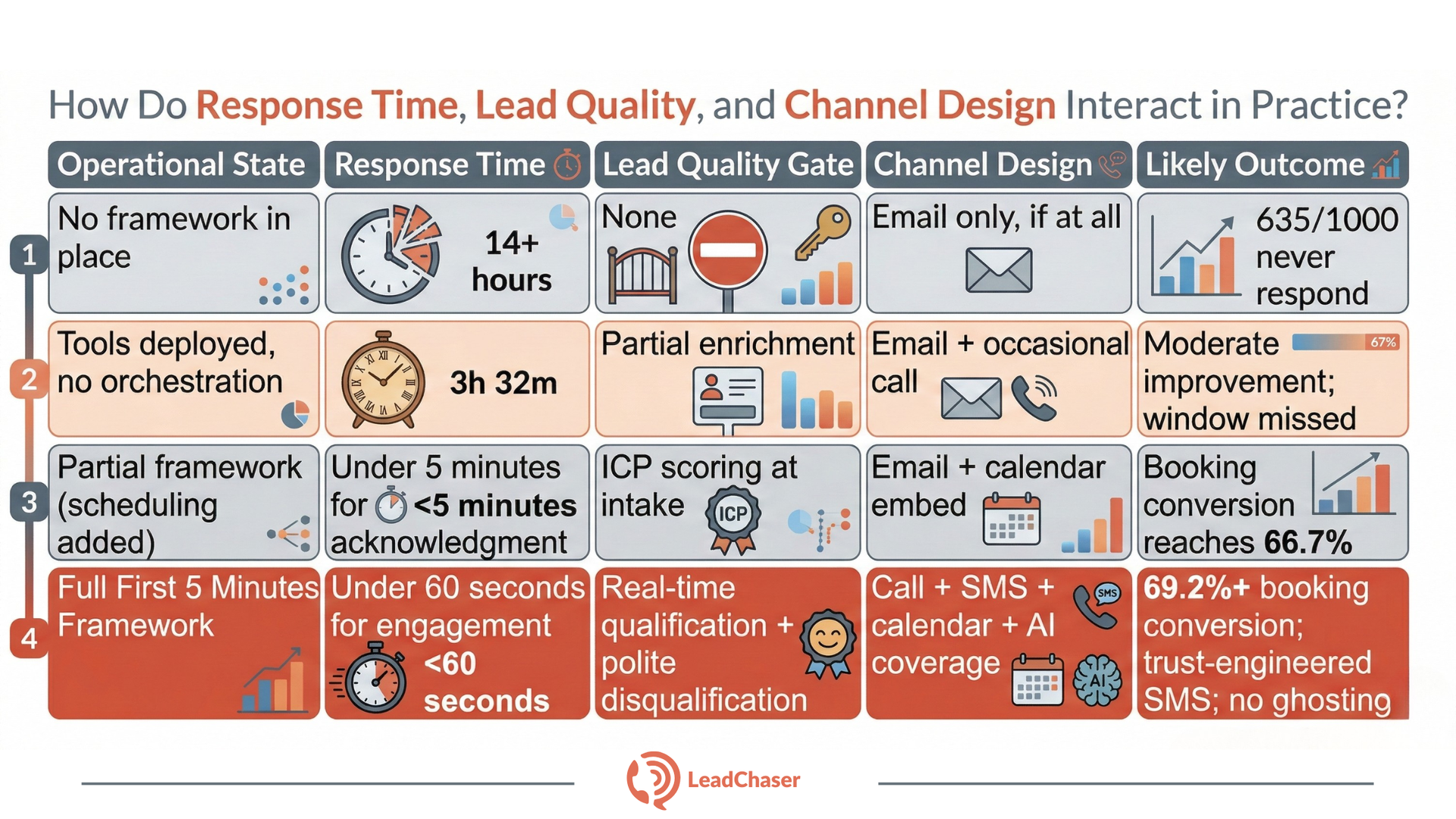
Operational StateResponse TimeLead Quality GateChannel DesignLikely OutcomeNo framework in placeAverage 14+ hoursNoneEmail only, if at all635/1000 never respond; 30% booking rate on the remainderTools deployed, no orchestration3 hours 32 minutes (with routing tools)Partial enrichmentEmail + occasional callModerate improvement; the window is still missedPartial framework (scheduling added)Under 5 minutes for acknowledgmentICP scoring at intakeEmail + calendar embedBooking conversion reaches 66.7%Full First 5 Minutes FrameworkUnder 60 seconds for engagementReal-time qualification + polite disqualificationCall + SMS + calendar + AI coverage69.2%+ booking conversion; trust-engineered SMS; no ghosting
The table makes visible what the data implies: response time alone does not drive conversion. Lead management without qualification wastes the window. Channel deployment without trust engineering undermines the effort. All three must be designed together. Effective lead generation strategies must integrate these elements to ensure that sales leads are engaged promptly and efficiently, leveraging AI in sales to enhance performance.
What Are the Lead Generation Strategies That Actually Protect the Five-Minute Window?
The lead generation strategies that protect the five-minute window share one characteristic: they treat post-form experience as part of demand generation, not as an afterthought handed off to sales ops.
Specifically, the lead generation strategies that perform are those that embed scheduling at the point of form submission, use real-time enrichment to segment and route before any human touches the record, deploy multi-channel engagement sequences that are pre-built rather than triggered manually, and design trust signals into every touchpoint so that fast outreach does not feel like fraud.
The lead generation strategies that fail are those that optimize click-through rates and cost per lead while ignoring what happens after the conversion event. A $20 cost-per-lead becomes a $200 cost-per-opportunity when 90% of sales leads are lost in the response gap.
The five-minute window is where lead generation strategies either pay out or evaporate. It is the last mile of demand generation and the first mile of revenue generation. Treating it as someone else's problem is the most expensive operational decision a B2B team can make. By integrating AI in sales, teams can ensure that their lead management processes are optimized for speed and efficiency, thereby protecting the five-minute window and maximizing conversion rates.
What Is the Eight-Step Checklist for Engineering Your First 5 Minutes?
What Exactly Should Your Team Implement to Build the Framework?
This checklist is designed for revenue operations leaders, sales engineers, and growth teams who are ready to move from intent to implementation. Every step maps directly to a specific interval in the First 5 Minutes Framework.
**1. Audit your current response time by channel.**Pull actual response data from your CRM for the last 90 days: average time to first email, first call attempt, and first SMS. Segment by lead source. If you cannot produce this data in under an hour, your lead management infrastructure needs a reporting layer before anything else.
**2. Design a post-form confirmation message that creates certainty.**Replace generic thank-you pages with specific, expectation-setting confirmations. Include who will contact them, through what channel, and within what time frame. Add a one-tap intent prompt: Book now, Call me now, or Text me options.
**3. Implement real-time enrichment and qualification scoring at intake.**Use enrichment tools to validate company, role, and ICP fit before the lead is routed. Build a disqualification path that closes the loop with the prospect immediately rather than ghosting them.
**4. Rebuild your routing logic around account match, intent signals, and rep capacity.**Remove pure round-robin routing. Assign fallback owners to every territory and segment so that no lead waits on a single rep's availability. Treat routing as a revenue architecture decision, not a CRM setting.
**5. Automate the call-attempt trigger at the moment routing completes.**The call attempt should fire as an automated system action, not a manual rep decision. Build in voicemail-drop logic for cases where the call does not connect on the first attempt.
**6. Design trust-engineered SMS templates using identity, intent, and opt-out language.**Every outbound SMS in this window must include the brand name, the specific reason for texting, a reference to the action the prospect took, a clear choice-based call to action, and an opt-out path. Review your consent architecture against theFTC Telemarketing Sales Rule requirementsbefore deploying.
**7. Embed instant scheduling into the post-form confirmation flow.**Based on Chili Piper's benchmark data, this single change can double your booked-meeting conversion rate. Scheduling should be available immediately, before the first call attempt, as a parallel conversion path rather than a fallback.
**8. Deploy AI-assisted coverage for after-hours and overflow scenarios.**Use AI in sales to draft the first personalized message, handle initial qualification conversations, and ensure that no lead goes untouched. Design the human handoff to ensure a seamless transition from AI to the rep while preserving the five-minute window.
FAQ
Q1) What are the best SOPs for lead response time management to ensure high conversion rates?
The best SOPs for lead response time management focus on engineering the first five minutes after a lead submission. This includes immediate acknowledgment of the lead, real-time qualification, accurate routing, and multi-channel engagement. Implementing AI in sales can further enhance these SOPs by automating initial responses and ensuring that sales leads are engaged promptly. Key steps include:
- Designing a post-form confirmation message that sets clear expectations.
- Using real-time enrichment to instantly qualify sales leads.
- Automating call attempts and SMS outreach to reduce response time.
- Embedding instant scheduling options to convert intent into meetings.
These SOPs ensure that lead management is both efficient and effective, maximizing conversion opportunities.
Q2) Which are the best tools for immediate follow-up after lead submission to maximize engagement?
The best tools for immediate follow-up after lead submission include those that integrate seamlessly with your CRM and automate the initial engagement process. Key tools include:
- **Chili Piper:**Enables instant scheduling and routing, significantly reducing response time and improving conversion rates.
- **RevenueHero:**Provides real-time enrichment and qualification, ensuring that sales leads are engaged promptly and efficiently.
- **LeadChaser:**Offers a comprehensive solution for calling, SMS, routing, and qualification, all designed to optimize the five-minute window.
- AI in sales****tools: Automate initial responses, draft personalized messages, and handle qualification conversations, ensuring that no lead goes untouched.
These tools are essential for effective lead management and ensuring that lead generation strategies are executed flawlessly.
Q3) What are the best CRM solutions for reducing response times and improving lead management?
The best CRM solutions for reducing response times and improving lead management are those that integrate automation, real-time data enrichment, and multi-channel engagement. Key CRM solutions include:
- **Salesforce:**Offers robust automation capabilities, real-time data enrichment, and seamless integration with tools like Chili Piper and RevenueHero. It is widely used for AI in sales applications.
- **HubSpot:**Provides a user-friendly interface with powerful automation features, making it ideal for small to mid-sized businesses looking to improve lead management.
- **Microsoft Dynamics 365:**Integrates well with other Microsoft products and offers advanced analytics and automation to improve response times and lead engagement.
- **Zoho CRM:**Known for its affordability and customization options, Zoho CRM is a good choice for businesses looking to optimize their lead generation strategies.
These CRM solutions are designed to streamline lead management, reduce response time, and improve overall conversion rates for sales leads.
Q4) How can AI in sales enhance lead response time and lead management processes?
AI in sales can significantly improve lead response times and lead management by automating initial engagement, personalizing outreach, and ensuring no lead goes untouched. Key ways AI in sales can improve these processes include:
- **Automated Responses:**AI can draft and send personalized messages immediately after a lead submission, reducing response time to near zero.
- **Real-Time Qualification:**AI tools can enrich and qualify sales leads in real time, ensuring that only high-value prospects are routed to sales reps.
- **Multi-Channel Engagement:**AI can coordinate outreach across email, SMS, and phone calls, maximizing the likelihood of engaging the lead promptly.
- **After-Hours Coverage:**AI can handle initial engagement outside business hours, ensuring sales leads are not left waiting until the next business day.
By integrating AI in sales into your lead management processes, you can ensure that your lead generation strategies are both efficient and effective, maximizing conversion opportunities.
Q5) What are the key metrics to track for optimizing lead response time and lead management?
Tracking the right metrics is essential for optimizing lead response time and lead management. Key metrics to monitor include:
- **Average Response Time:**Measure the time it takes to respond to a lead across different channels (email, phone, SMS). Aim to reduce this to under five minutes.
- **Conversion Rate:**Track the percentage of sales leads that convert into meetings or opportunities. This metric helps assess the effectiveness of your lead generation strategies.
- **Lead Quality:**Monitor the percentage of sales leads that meet your ICP criteria. High-quality leads are more likely to convert, so focus on improving this metric.
- **Engagement Rate:**Measure the percentage of leads that engage with your outreach efforts. High engagement rates indicate that your lead management processes are effective.
- **Routing Accuracy:**Track the percentage of leads routed to the correct sales rep. Accurate routing is crucial for reducing response time and improving conversion rates.
By tracking these metrics, you can identify areas for improvement in your lead management processes and ensure that your lead generation strategies are optimized for success. Integrating AI in sales can further enhance these metrics by automating and personalizing outreach efforts.
Works Cited
Chili Piper. "Form Conversion Rate Benchmark Report."Chili Piper, 2025,www.chilipiper.com/post/form-conversion-rate-benchmark-report.
Federal Trade Commission. "New FTC Data Show Top Text Message Scams in 2024; Overall Losses from Text Scams Hit $470 Million."FTC, 2025,www.ftc.gov/news-events/news/press-releases/2025/04/new-ftc-data-show-top-text-message-scams-2024-overall-losses-text-scams-hit-470-million.
Gartner. "Gartner Predicts by 2028, AI Agents Will Outnumber Sellers by 10x, Yet Fewer Than 40 Percent of Sellers Will Report AI Agents Improved Productivity."Gartner, 2025,www.gartner.com/en/newsroom/press-releases/2025-11-18-gartner-predicts-by-2028-ai-agents-will-outnumber-sellers-by-10x-yet-fewer-than-40-percent-of-sellers-will-report-ai-agents-improved-productivity.
Pew Research Center. "Internet Use, Smartphone Ownership, and Digital Divides in the U.S."Pew Research Center, 2026,www.pewresearch.org/short-reads/2026/01/08/internet-use-smartphone-ownership-digital-divides-in-u-s/.
RevenueHero. "B2B Lead Response Times: The State of the Industry."RevenueHero, 2025,www.revenuehero.io/blog/b2b-lead-response-times.
Salesforce. "State of Sales Report 2026."Salesforce, 2026,www.salesforce.com/news/stories/state-of-sales-report-announcement-2026/.
Workato. "Lead Response Time Study."Workato, 2025,www.workato.com/the-connector/lead-response-time-study/.