
Manual follow-up creates inconsistency, delays, and burnout across sales teams. This post explains why high-performing teams are replacing human-dependent follow-up with AI systems that ensure every lead is contacted, nurtured, and routed at the right moment.
TL;DR
- AI follow-up automation makes the five-minute response window achievable, which multiplies conversion odds.
- Sales teams save hours per week by offloading admin tasks to modern sales productivity tools, boosting morale and pipeline velocity.
- AI sales assistants keep every conversation moving: instant replies, scheduled next steps, and CRM updates without manual effort.
- Lead follow-up software runs multi-touch, multi-channel outreach consistently, so fewer prospects “ghost” and more deals move forward.
- When paired with lead calling services, AI ensures every inbound inquiry receives a timely, human-quality engagement, day or night.
Why are manual follow-ups failing modern sales teams?
Because manual follow-ups burn time and break consistency. Reps spend the majority of their week on administrative work, not selling, and most teams can’t maintain fast, multi-touch outreach by hand.
** Let’s be direct:**salespeople are drowning in busywork. Salesforce’s research shows that only about 28% of a rep’s week is spent on actual selling; the other 72% is swallowed up by non-selling tasks like data entry and deal hygiene (Salesforce).
That imbalance isn’t just inefficient, it’s exhausting. Roughly 90% of sellers report feeling burned out by mounting administrative pressures, context-switching, and unrealistic activity expectations (Salesforce). Stressed people don’t follow up consistently, and fatigued teams don’t win fast-moving deals.
The “speed-to-lead” problem compounds the issue. Authoritative research from Harvard Business Review found that responding to an online lead within five minutes dramatically boosts outcomes; in their analysis, fast responders were far more likely to make contact and move to a meaningful next step (Harvard Business Review). Yet manual follow-ups struggle to keep up, especially across time zones, weekends, and holiday periods.
This is why more leaders are adopting AI follow-up automation to remove the manual drudgery from initial and repeat outreach. And it’s why the most effective teams now standardize on lead follow-up software to orchestrate timely sequences across email, SMS, chat, and phone without relying on memory. When humans must do everything, look up contacts, dial, leave voicemails, type call notes, update the CRM, too many qualified leads go quiet after one or two attempts, even though it commonly takes 5–12 touches to close.
AI sales assistants change the pattern. They never forget a step, they don’t fatigue, and they can execute at any hour, making consistent engagement the default rather than the exception.
For organizations already investing in AI follow-up automation, the payoff is lower stress, higher response rates, and a healthier pipeline. Even teams that rely on lead calling services benefit when manual work (routing, scheduling, summarizing) is handled automatically and flawlessly.
If you’re ready to turn the page on manual reflexes, start by asking a simple question: “Which parts of our follow-up do reps dread or delay?” Those are the first targets for sales productivity tools, and the fastest route to meaningful gains.
How fast should you respond to a lead to maximize conversions?
Within five minutes, ideally faster. The odds of contact and conversion plummet after the first few minutes.
Let the numbers guide your approach. InThe Short Life of Online Sales Leads, HBR shows how crucial it is to respond quickly. Teams that adopt AI follow-up automation consistently meet that standard without burning out their reps. When a new prospect fills out a form, clicks a key call-to-action, or replies on social, automated workflows can trigger the next step immediately, an email, a text, a calendar invite, or even a phone connection, so you’re first in the door.
Over time, you can refine the timing based on performance data (e.g., faster follow-up on product-qualified signups, more nurturing for top-of-funnel content downloads). If you’re running outreach by hand, it’s hard to sustain this speed at volume. Lead follow-up software bridges that gap by matching behavior-based triggers with the right channel, including phone. And when you pair those triggers with lead calling services for high-intent prospects, your team can create “now” moments on demand: the right person, calling at the right time, with the right context.
Manual vs. AI-assisted follow-up at a glance
AspectManual Follow-UpAI-Orchestrated Follow-UpSpeed-to-leadMinutes to hours; inconsistentSeconds; consistent via AI follow-up automationCadence consistencyHighly variable; easy to miss stepsReliable sequences via lead follow-up softwareHuman effortHigh; repetitive admin drains energyLow; AI sales assistants handle routine workLive voiceAd-hoc; dependent on rep availabilityCoordinated through lead calling servicesData hygieneManual entry; error-proneAutomated logging via sales productivity tools
How do AI sales assistants eliminate follow-up gaps 24/7?
By taking on the tedious steps humans forget or delay, and doing them instantly, every time.
- A new inbound demo request arrives at 10:13 p.m. your time. AI sales assistants send a personalized acknowledgement immediately, offer up two or three meeting slots, and drop the prospect into a tailored sequence if no slot is chosen.
- The next morning, the system routes the lead to the right rep based on territory and product interests, then automatically creates the opportunity and tasks in your CRM.
- After the discovery call, AI captures the summary, highlights risks, logs action items, and schedules next steps, no manual notes required. Zoom reports teams are reclaiming time by auto-creating call summaries and follow-ups directly in the CRM, cutting admin-heavy documentation by roughly 76% and contributing to 10–15% higher close rates (Zoom).
This approach blends AI follow-up automation with your favorite sales productivity tools so everything just happens: sequences launch, handoffs are smooth, and records stay accurate. Meanwhile, lead follow-up software ensures that every contact gets the right cadence: five touches, seven touches, twelve touches, whatever your motion requires. And when a conversation needs a live voice, your tech can integrate with lead calling services to place or schedule outreach with the best available rep, not just anyone who happens to notice a Slack ping.
The outcome is simple: fewer dropped balls, fewer “ghosted” prospects, and more confident reps who spend their day building relationships instead of chasing tasks.
What ROI can teams expect from AI follow-up automation?
Expect measurable savings in time, higher conversion rates, and a cleaner pipeline, often within weeks.
- Teams using modern sales technology, including automation, see roughly 10–20% higher ROI and 20% fewer human errors in their processes (MarketsandMarkets).
- Sellers commonly save about five hours per week by offloading repetitive admin and dialing to automation, almost a full workday reclaimed every two weeks (MarketsandMarkets).
- Organizations that exceeded revenue targets overwhelmingly credit their tech stack as a key driver; 61% said these tools were pivotal to outperformance (MarketsandMarkets).
- Salesforce reports that 83% of teams using AI grew revenue last year, compared with about 66% of teams without it (Salesforce).
Roll those impacts up, and the pattern is clear: when you put AI follow-up automation at the heart of your motion, response times shrink, touches increase, and reps spend more hours actually selling. It also tightens your forecasting. Because your outreach is consistent, you learn which touchpoints move the needle for each segment. That feedback loop lets you continually improve your sales productivity tools, content, and cadences.
There’s a morale benefit, too. When reps aren’t stuck typing notes, rebuilding the same emails, and triple-checking the CRM after hours, they have more energy for high-value conversations.
In short, lead follow-up software plus process discipline gives your team back control. Your managers can coach, your sellers can sell, and your pipeline will reflect that shift. And when high-intent prospects prefer a live touch, adding lead calling services to the mix gives you a reliable, human-quality response at precisely the moment it matters.
How is AI changing sales roles and daily workflows?
It’s moving reps from task-doers to strategists. Machines handle the repetitive steps; people focus on discovery, diagnosis, and deal strategy.
Today, nearly half of sellers already use AI for activities like writing emails and scoring leads, and that number is climbing quickly (HubSpot). Salesforce found that 94% of sales organizations intend to streamline their tech stacks to enable reps to spend more time selling (Salesforce). Analysts project that by 2028, conversational GenAI interfaces will handle a major share of B2B sellers’ routine work (MarketsandMarkets).
What does that mean in the trenches? AI sales assistants will launch most first-touch communications, nurture sequences will adjust dynamically based on behavior, and CRM hygiene will be largely automatic. AI follow-up automation will ensure “no inquiry left behind” while surfacing at-risk deals to humans at the right moment. Reps will still be the closers, but with better timing, richer context, and far less grunt work.
Under the hood, your sales productivity tools become the connective tissue between marketing, sales, and success. Lead follow-up software aligns the handoff between teams and integrates with revenue intelligence to flag buying signals or churn risk. And for teams that need immediate human outreach, lead calling services remain the reliable “voice button” within this larger automated system.
How can a sales leader get started in 30 days?
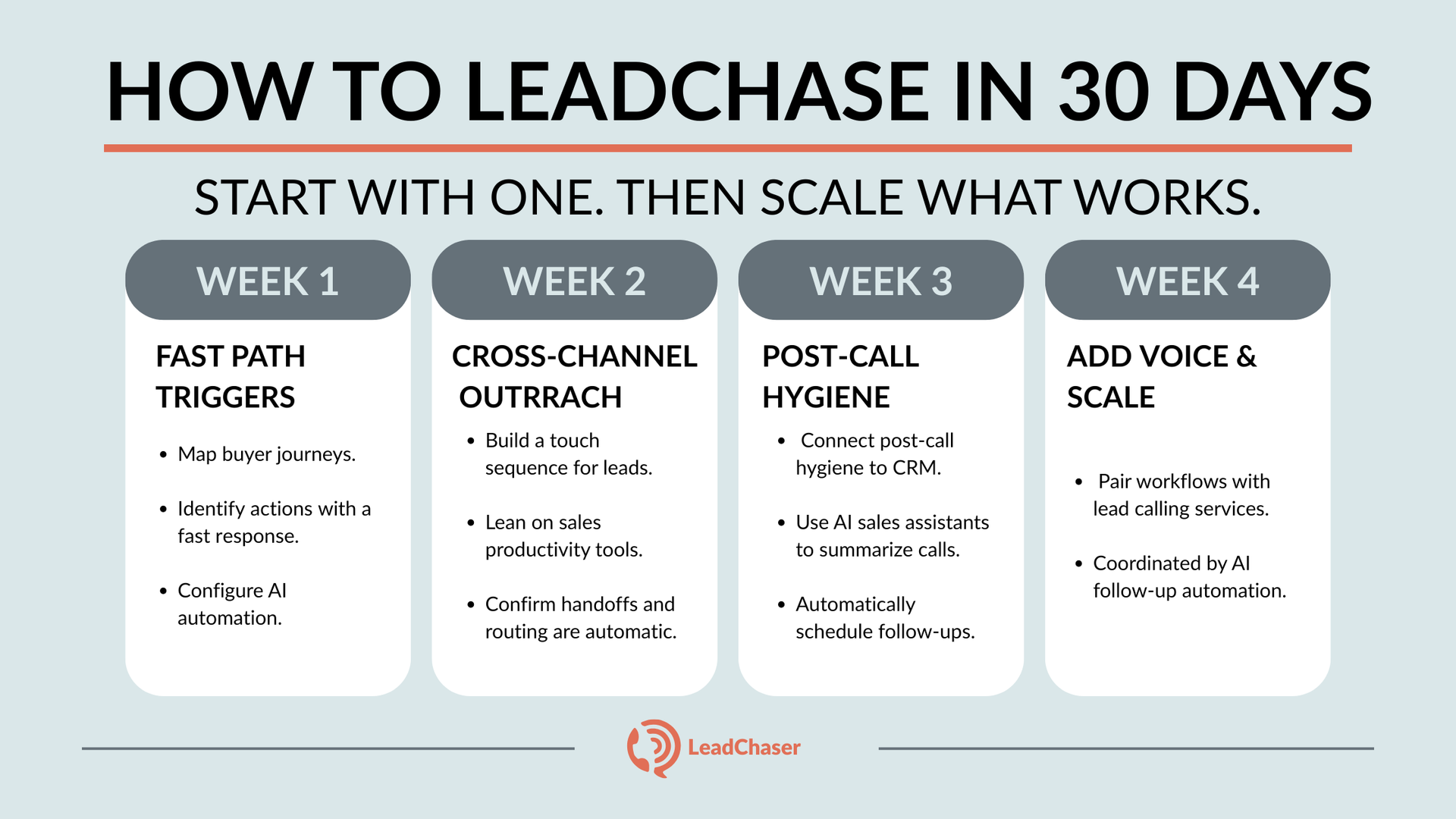
Start with one pipeline, one segment, and one play that matters. Then scale what works.
- **Week 1:**Map your buyer journeys and define “fast path” triggers. Identify actions that warrant a near-instant response (e.g., demo request, pricing page visit, trial signup). Configure AI follow-up automation so those triggers launch the first touch immediately, email, SMS, calendar link, or call.
- **Week 2:**Build a 5–12 touch sequence for new inbound leads. Your goal is consistent, cross-channel outreach. Lean on sales productivity tools to personalize with dynamic fields and behavioral logic. Confirm handoffs and routing are automatic inside your lead follow-up software.
- **Week 3:**Connect post-call hygiene to your CRM. After every meeting, use AI sales assistants to summarize the call, extract action items, record next steps, and automatically schedule follow-ups.
- **Week 4:**Add voice. For high-intent prospects, pair your workflows with lead calling services to place or schedule timely calls. For everything else, let your sequences do the heavy lifting, coordinated by AI follow-up automation.
Interested in a quick start without heavy lift? See how LeadChaser handles end-to-end orchestration, from instant outreach to scheduled calls, so your team can launch fast. Explore the platform atLeadChaser, review capabilities onProduct, and check current plans atPricing. You can also browse practical playbooks on theLeadChaser blog.
How do you choose the right platform without getting burned?
Look for reliability, clear ROI, and fit for your motion, not just shiny features.
- **Data capture and CRM sync:**Does the system auto-log calls, emails, notes, and tasks accurately? Can it summarize meetings into clear next steps and associate them with the right records via sales productivity tools?
- **Speed-to-lead automation:**Can you respond within seconds to qualifying triggers using AI follow-up automation? Is it easy to create, test, and tweak sequences without a developer?
- **Personalization at scale:**Can you tailor messages by segment, role, and behavior? Do you get templates and testing tools that make improvement routine inside your lead follow-up software?
- **Reporting that matters:**Can you track time-to-first-touch, touches-to-meeting, and conversion by segment and channel?
- **Channel breadth:**Does it support email, SMS, chat, and voice? For phone-based outreach, confirm robust integrations so reps can place calls or auto-schedule them via lead calling services without friction.
- **Security and governance:**Are permissions granular? Can you easily set regional compliance rules? Is the audit trail clear?
When you’re researching the best options, verify you can launch a pilot within days and see an early signal within two weeks. This is also the right moment to consider whether your AI sales assistants integrate deeply enough with your CRM to keep your pipeline clean. Finally, make sure your short list includes lead follow-up software and sales productivity tools that turn raw activity into actionable insights for your managers, and that play nicely with lead calling services so voice is a seamless part of your motion.
What common pitfalls should you avoid?
Don’t automate chaos, over-prospect, or ignore governance. Each mistake undercuts trust and performance.
- **Automating a messy process:**If your routing rules or stages are unclear, AI follow-up automation will replicate the confusion at scale. Start with one clean path, one segment, one goal, and expand from there.
- **Overloading prospects:**Relevance beats volume. Calibrate cadence and content to engagement signals. Quality beats the “more emails” reflex every time, even with great sales productivity tools.
- **Ignoring privacy and compliance:**Permission rules and local regulations vary. Centralize your opt-in/opt-out logic and track consent by region. Establish a clear DNC process and respect it across channels, including any lead calling services you employ.
- **Underfunding change management:**Good tech fails when people aren’t trained. Document your flows, coach to metrics, and celebrate quick wins. Let AI sales assistants show the team what “good” looks like.
If you do nothing else, define response-time targets and watch them daily. The teams that succeed treat time-to-first-touch and touches-to-meeting as non-negotiable health metrics. Back that discipline with the right sales productivity tools and the right lead follow-up software, and you’ll see results quickly. Layer in AI follow-up automation to keep the cadence running, and empower your AI sales assistants to take the tedious steps off your team’s plate. If your motion depends heavily on voice, ensure your integrations make it easy to initiate or schedule calls through trusted lead calling services without extra steps or data silos.
What does success look like? A short story
Imagine a mid-market SaaS team with 12 reps and a steady stream of inbound. Before automation, leads arrived unevenly: some got a quick reply, others waited until “someone had time.” Reps toggled between tabs, retyped the same notes, and left the CRM half-updated. Meetings were lost in the shuffle, managers had little visibility, and morale slipped as the to-do list grew.
They turned on AI follow-up automation for demo requests, connected it to their CRM, and launched a six-touch, cross-channel sequence for all new inquiries. They also adopted sales productivity tools to create dynamic emails and to track speed-to-lead, touches-to-meeting, and conversion by segment. AI sales assistants handled call summaries and next steps in the CRM. For high-intent leads, they coupled the flow with lead calling services so a rep could engage by phone within minutes. Over the next eight weeks, they expanded into a full system anchored by lead follow-up software.
The result? Response time dropped from hours to minutes. The average number of touches per lead jumped into the recommended range. Review meetings changed from “Why did this slip?” to “Here’s what worked, let’s do more of it.” Close rates rose by low double digits, consistent with industry findings, and rep morale rebounded because the tedious work was off their plates. Their leadership saw clearer forecasts, cleaner data, and a smoother handoff from marketing.
This is what good looks like: a calm team, a consistent process, and a compounding pipeline.
If you want a blueprint like this, take a look at how LeadChaser orchestrates instant responses, multi-touch sequences, and automated CRM hygiene:leadchaser.ai. You can dig into capabilities here:Product, and compare plans here:Pricing.
Quick-hit plays you can launch this week
- **Instant demo-responders:**Trigger an email and SMS within 60 seconds via AI follow-up automation, plus a calendar link offering 3 time slots.
- **Voicemail-to-text assist:**Use AI sales assistants to summarize incoming voicemails and trigger follow-ups through your lead follow-up software.
- **“Nudge to meeting” sequence:**A three-step micro-cadence coordinated by your sales productivity tools that escalates to lead calling services after two non-responses.
FAQ
Q1) How quickly can a mid-size team see impact after adopting the best AI tools for lead followup automation?
Many teams see early gains within two to four weeks, especially in time-to-first-touch and meeting volume. Start with one or two high-intent triggers, connect them to AI follow-up automation, and measure rigorously. A focused pilot reveals how lead follow-up software and sales productivity tools perform in your environment before scaling. If phone outreach is central to your motion, integrate lead calling services to test live-connect SLAs from day one, supported by AI sales assistants that automatically generate post-call notes.
Q2) What’s the best way use AI lead followup tools for customer relationship management?
Use AI follow-up automation for speed, consistency, and data hygiene, while reserving human conversations for key inflection points. Let automated sequences warm early-stage prospects, then route high-intent actions to a rep or auto-schedule calls through lead calling services. AI sales assistants should surface context so every interaction feels personal. In practice, lead follow-up software handles timing and orchestration, while sales productivity tools enable teams to tailor messaging by segment.
Q3) How do I make data the center of our follow-up strategy using AI tools for customer lead tracking and engagement?
Define SLAs for first response, set target touches by segment, and track performance by channel. Choose lead follow-up software that visualizes time-to-first-touch, touches-to-meeting, and conversion by source. AI sales assistants automatically enrich records, so dashboards tell the full story. Then refine cadences using sales productivity tools and validate voice-channel outcomes through lead calling services with documented SLAs. AI follow-up automation ensures learnings compound over time.
Q4) What if our lead volume is low—does automation still help?
Yes. When volume is low, speed and relevance matter even more. AI follow-up automation ensures instant first touches, while AI sales assistants keep records up to date. Lead follow-up software prevents missed inquiries, and sales productivity tools free reps to research and personalize outreach. If a small number of leads show high intent, lead calling services create fast voice-to-voice engagement when it matters most.
Q5) How should we think about consolidation vs. best-of-breed?
If your stack is fragmented, consolidation can improve data integrity and adoption. But never sacrifice fit for simplicity. Ensure your core needs, AI follow-up automation, lead follow-up software, sales productivity tools, AI sales assistants, and lead calling services are fully supported by robust integrations. Run a two-week pilot, confirm measurable flows launch in days, and validate reporting before scaling.
The bottom line
We’re at the end of manual follow-ups, not because people don’t care, but because the stakes are too high and the work is too repetitive to trust to memory. When you automate the tedious parts with AI follow-up automation, your team shows up where it counts: in conversations, in discovery, and at the finish line. Pair lead follow-up software and sales productivity tools to keep momentum, let AI sales assistants handle the paperwork you used to dread, and weave in lead calling services for the human moments that close deals. You’ll move faster, feel calmer, and win more.
Ready to see this in your own pipeline? Start a focused pilot with LeadChaser: spin up instant responses, orchestrate multi-touch outreach, and auto-update your CRM without adding more tabs to your life. Explore now atleadchaser.aiand book a walkthrough atleadchaser.ai/product. If you’re convinced and want to launch this month, compare plans atleadchaser.ai/pricing.
Works Cited
- Harvard Business Review. “The Short Life of Online Sales Leads.”Harvard Business Review, 23 Mar. 2011,https://hbr.org/2011/03/the-short-life-of-online-sales-leads.
- HubSpot. “The State of AI in Sales.”HubSpot Blog, 2024,https://blog.hubspot.com/sales/state-of-ai-sales.
- MarketsandMarkets. “Best Sales Automation Software for Growing Teams: Numbers and Trends.”MarketsandMarkets, 2024,https://www.marketsandmarkets.com/AI-sales/best-sales-automation-software-for-growing-teams.
- Salesforce. “State of Sales: 5th Edition—Research Findings.”Salesforce Newsroom, 2023,https://www.salesforce.com/news/stories/sales-research-2023/.
- Salesforce. “AI Agents: Trends and Statistics.”Salesforce Newsroom, 2024,https://www.salesforce.com/news/stories/ai-agents-statistics/.
- Salesforce. “Sales Burnout: Why It Happens and What to Do About It.”Salesforce Blog, 2023,https://www.salesforce.com/blog/sales-burnout/.
- Zoom. “AI Can Lighten the Load on Sales Teams.”Zoom Blog, 2023,https://www.zoom.com/en/blog/ai-can-lighten-the-load-on-sales-teams/.