
The faster you speak to a qualified prospect, the higher your chances of closing the deal. Learn how to leverage LeadChaser's instant calling and conversational AI to engage a lead the second they submit a form, automatically qualify them, and instantly transfer them to your top sales rep in real-time.
TL;DR
According to Hennessey Digital’s 2025 Lead Form Response Time Study, 26% of the 200 businesses studied did not respond to online leads at all. Just 25% of the businesses responded to online leads within 5 minutes, suggesting that responding quickly to online leads is now a key factor in competing for opportunities.
71% of customers will abandon a purchase that is irrelevant to them. 88% of customers are more likely to make a purchase if the experience is personalized in real time. (Twilio, 2025)
54% of sales teams are already using AI agents, and 9 in 10 plan to use them in the next 2 years. So you're already at a competitive disadvantage to your peers. (Salesforce State of Sales, 2026)
What tool do you need after a lead has been submitted? The answer has shifted from email automation to conversational AI that dials, qualifies, and connects a prospect to a live sales representative within 60 seconds.
With Instant Lead Calling, LeadChaser connects leads with agents as fast as 1 second. Here, Planet Stone achieved a 47.73% lead-to-conversion rate. (LeadChaser Case Studies)
What Happens in Those First 60 Seconds After a Lead Submits a Form?
In the first minute after a prospect submits a form to your website, you have your most promising shot at the sale, and then it's all but lost. The window of Buyer Intent is brief, for 60 seconds, the prospect is most motivated to buy from YOU, and then, poof, they're distracted, deluged by competitors, and their intent to purchase loses its sense of urgency.
The conversation around the state of business pipelines is often framed in terms of motivation and making the most of incoming leads. However, the real issue may have more to do with a process problem and can be addressed with solutions for rapid lead engagement. This is made clear by the findings ofHennessey Digital's 2025 lead-form response time study, which observed over 150,000 data points and over 1,300 websites. The result: A mere 33% of businesses can respond to a lead within 10 minutes, with 39% waiting over two hours or failing to respond altogether.
You have to understand the psychology of the moment. Thanks to neuroscience, we know that this is the moment when the prospect is “primed”, mentally rehearsing their desired outcome. They have not yet begun to compare you (favorably, we hope) to competitors, nor to worry about budget. You want to pick up the transfer within 60 seconds to deliver intelligent sales dialogue that instantly knows where the prospect is in the buying process. The 60-second handoff methodology is all about hitting the prospect at this precise moment of readiness.
Speed alone isn’t enough; speed + relevance wins. The best tools for immediate follow-up after lead submission ensure that this relevance is maintained by initiating a live conversation rather than an asynchronous email or SMS.
How the 60-Second Handoff Actually Works
A 60-second handoff is automated and in real time. In a 60-second handoff, every lead submitted from a form is qualified and set up for a live conversation with a sales team member within ONE MINUTE. This is not a single technology but a chain of automated, AI-driven events that take hours of tedious work out of the sales team’s hands and streamline the process down to seconds.
The architecture of a high-performing 60-second handoff generally follows a four-step process:
Stage 1 (0–5 seconds): Instant outbound dial
The moment you paste form details into LeadChaser, or a user submits a form, the software initiates an outbound call to the prospect’s number. LeadChaser’s Instant Lead Calling technology enables you to make these critical connections in ONE SECOND or less, straight off the bat, from the very instant a form is submitted, making it an instantaneous outbound dial. This is one of the best tools for optimizing lead routing efficiency in high-volume environments.
Stage 2 (5–20 seconds): Conversational AI micro-qualification
Instead of putting customers on hold or blasting out generic SMS messages, conversational AI starts interacting with them the instant they text in. This is NOT a pitch but rather a quick exchange to determine intent, desired timeline, service area (or budget band), and other fit criteria that your team has pre-defined. Your reps then open up the live conversation armed with the relevant qualification information to ensure maximum relevance. This step is critical in the solutions for rapid lead engagement list.
Stage 3 (20–45 seconds): Routing decision
Based on the output of the AI’s qualification and lead-scoring process, the system applies your established routing logic to determine which Sales Rep is best suited for the prospect, using criteria such as territory, specialty, availability, and lead score. Top-rated AI lead routing software for sales teams makes these routing decisions in real time without the need for a dispatcher, a queue, or even a manual CRM lookup.
Stage 4: Warm live transfer with spoken and CRM summary (45–60 seconds)
Customers are transferred live to sales representatives with the full context of the customer's query provided. The sales representative receives a verbal summary of the customer's requirements, the urgency of the request, and the customer's eligibility for a quote. Additionally, an automated summary is also updated in the CRM. The sales representative's first words on the call are tailored to the buyer's situation, not a generic cold-call greeting.
The fast follow-up consists of four steps and allows you to compete for a hand on a trick successfully. Speed is crucial in these steps, and without context, there is a strong chance that the follow-up will fail. The best tools for immediate follow-up after lead submission ensure that this context is preserved and delivered in real time.
Why Is Speed-to-Lead Data So Inconsistent Across Industries, and Which Benchmarks Should Sales Leaders Actually Trust?
Most statistics on speed-to-lead don’t actually measure speed to first live human contact (the one that matters to revenue). Current statistics track speed to first touch, a completely different animal. This affects how companies design their lead engagement strategies and tactics.
The most recent and most reliable benchmark is Hennessey Digital’s 2025 lead form response time study. This is their fifth year conducting this same study, and it is impressive that they can use the same methodology year after year to gather data from over 1,300 different websites.
The data is somewhat disheartening, though. On average, businesses are responding to their own lead form submissions in 13 days, with 26% of businesses not responding at all. More disheartening, however, is that just 25% of businesses are responding in under 5 minutes, and this number has only increased from 13% in 2021. The most successful businesses in the study responded to leads in an average of 2.5 minutes within their first week of implementing automation on their website. The gap between the top 25% and average businesses is a sustainable competitive advantage.
So, what is “good” in real-time contact? The ContactBabel’s US Contact Center Decision-Makers’ Guide 2025 report states that the average time to answer for inbound call centers is 99 seconds (median 68 seconds). Clearly, for a well-established, professional contact center with appropriate staffing, operational protocols, SLAs, and years of fine-tuning, achieving a less than two-minute response time is achievable and what you would expect. Therefore, an AI-assisted live transfer answer on the other end of a call within a sub-60-second ring time is absolutely achievable as a process choice.
The sales leader takeaway here is to stop measuring first-touch response time and start measuring time-to-live-human, the KPI that truly matters for evaluating competitive engagement infrastructure. The best tools for optimizing lead routing efficiency focus on this metric to ensure leads are connected to the right rep as quickly as possible.
What Are the Best Tools for Immediate Follow-Up After Lead Submission, and How Do They Differ from CRM Automation?
Differing from traditional CRM automation, the best tools for immediate follow-up after lead submission do not send an email, SMS, or assign a task; instead, they instantly begin a live voice conversation with the lead. While traditional CRM automation is an asynchronous process, sending a signal and waiting for a response, tools like LeadChaser are a synchronous process, seizing on the lead’s intent in real time.
Your typical CRM workflow looks something like this: a lead fills out a form, the CRM makes a contact, a task is assigned to a rep, the rep gets notified, the rep decides when to call, and by the time they pick up the phone, the lead has likely spoken to a competitor. Traditional CRM systems are slow by nature.
The best tools remove every manual step from the loop between a lead submission and an outbound call (i.e., form submission, manual forwarding to a sales team, manual notification to reps, manual addition as an email lead). They keep the form submission as the trigger and the outbound call as the immediate response, but nothing in between. For those looking at options, we’d recommend tryingLeadChaser's platformand seeing how Instant Lead Calling can reduce the gap to as little as 1 second.
But what does all this really mean in terms of practical outcomes? The insurance industry case study provided by LeadChaser showed a 20.1% connection rate among re-engaged opt-in leads, more than 10 times the industry average of 1.8%. This is equivalent to 20 calls per hour from re-engaged leads, versus four hours of calling to get one connected lead. Rather than throwing more salespeople at the follow-up bottleneck, LeadChaser can eliminate the problem altogether and instantly begin following up on leads submitted just moments before.
AI-Powered Lead Routing Software for Sales Teams Stands Out from the Simple Round-Robin Assignment—Here's Why!
The top-rated AI lead routing software for sales teams uses real-time, multi-variable decision logic to route a lead to the salesperson most likely to successfully sell to that prospect, not just next in a round-robin rotation. Round-robin routing is meant to ensure fair distribution of leads in volume-driven environments. However, performance in a high-velocity sales environment requires a different approach.
However, the standard round-robin approach typically only considers the assignment of one variable: the sequence of assignments as reps move through their workday. It does not account for factors such as rep availability, reps’ historical close rates for specific lead types, geographic or specialty expertise, or whether the rep is currently on another call. Leads and reps are treated as anonymous and equivalent entities.
Our pick for the top-rated AI lead-routing software for sales teams gives sales teams the power to evaluate multiple criteria at once, including lead score, qualification criteria, available reps in real time, territory rules, product-line expertise, and SLA requirements. Once leads satisfy some or all of the qualification criteria, the routing engine identifies the best sales rep and conducts a live transfer, not in order, but by best fit.
LeanData’s 2025 B2B Lead Response Time Playbookreveals how SUSE improved its speed-to-lead by 70% in just one quarter, consistently responding to leads in 2.68 business hours or less, 100% of the time. And they did it all with no increase in headcount. Learn how SUSE’s innovative use of intelligent routing logic, SLA governance, and escalation logic helped them meet the demands of modern buyers. Click to download The 2025 B2B Lead Response Time Playbook.
In addition, CiBX also enforces SLAs that traditional round-robin distribution systems cannot. If a routed rep doesn’t accept the transfer promptly, the lead is automatically routed to the next available and qualified rep, all without administrator intervention. This is routing, true revenue-generating routing, taken to the next level.
How Do Solutions for Rapid Lead Engagement Protect Revenue Without Overloading the Sales Team?
To protect and drive revenue, we work with clients to develop the best solutions. Using AI-powered tools, we integrate a qualification step into the pipeline to bridge the gap between the volume of leads and the overworked sales reps, enabling valuable conversations between the two. The hassle of rapid follow-up is often the flood of unqualified leads being pushed to reps who are trying to respond as quickly as possible. We work with technology that is designed to avoid these issues.
A micro-qualification occurs within the conversational AI solution to confirm lead value before a live transfer. Before a lead is transferred to a rep, the conversational AI solution determines whether the lead intends to buy, is on a relevant timeline, and meets other criteria. If a lead doesn’t meet minimum thresholds (e.g., incorrect geography, outside the budget band, timeline too far out), the solution can route the lead to alternative channels such as SMS, a scheduled callback, or a nurture sequence. Only leads that have met the minimum qualification criteria are connected with a live rep by phone.
This means reps are answering fewer calls but better ones. And according to HubSpot’s upcoming 2025 State of Sales report, findings support this: 84% of AI-adopting sales professionals say AI helps them save time and be more productive, and 82% say AI provides better insights to drive sales.
Planet Stone is a home services company. As a LeadChaser client, they’ve experienced some amazing results with our routing technology and lead qualification. In one recent example, the team achieved a 47.73% lead-to-conversion rate. That means 63 leads turned into opportunities within minutes of lead submission. We’ve seen this type of result on accounts that don’t just get a flood of leads; they need those rare, qualified leads routed right to the reps at the exact moment to convert.
Sub-Second Lead Connection Time – The New Sales Tech Standard
Why is sub-second lead connection time becoming the new standard? Sub-second lead connection time is now the new benchmark in digital sales because any delay over a few seconds comes with significant revenue implications. Why? Because companies that utilize AI-powered calling to connect with leads while manually pursuing those that follow up directly with customers are at a serious competitive disadvantage that compounds over time and can lead to dire financial consequences for those who fall behind.
The answer stems from three distinct forces at work in the world today: buyer expectations, competitive behavior, and technological capabilities. Online shoppers expect immediate responses, whether it be from an e-commerce site, customer support chatbots, or payment confirmation. They simply do not have time to wait for a response or feel annoyed by a 13-minute wait time that clearly indicates indifference. Insights from communications platform Twilio, in its 2025 report, found that 71% of consumers believe their experiences with brands and retailers are irrelevant, and 88% of customers are more likely to purchase from a brand if the experience is personalized in real time.
The competitive landscape is also evolving rapidly, according to the findings from Salesforce’s 2026 State of Sales report. At the same time, the report found that 54% of sales teams are already using AI agents, and nine in ten plan to use them in the next two years. Those companies connecting with customers in sub-second timeframes are not ahead of the curve; they are setting a new bar for others to follow.
When a system like LeadChaser’s Instant Lead Calling can connect a lead in a lead generator’s team within a single second, and others are doing it, a new standard enters the market. Why? Because the cost of not meeting this new standard is a lost deal to whoever does. The best tools are designed to meet this standard, ensuring that no lead is left waiting.
What Are the Best Tools for Optimizing Lead Routing Efficiency in a High-Volume Sales Environment?
For organizations juggling huge volumes of leads, the most effective tools for optimizing lead routing efficiency will likely integrate three features: real-time lead qualification, SLA-based assignment rules, and automatic escalations, all streamlined into a unified workflow. Here, efficiency isn’t measured by how fast a lead is routed but whether it’s routed to the right rep at exactly the right time.
Single, unified views | Simple data input | Fast decision-making | Quick setup and configuration processes.
1. Real-time trigger architecture
Our routing architecture determines the appropriate lead routing profile the moment a form is submitted, rather than after a batch sync or CRM refresh cycle. Allowing time-to-live-human (ttlh) to increase by amplifying delays in triggering the routing process was not acceptable.
2. Multi-variable rep matching
The best tools****will consider availability, specialty match, territory, and/or history with the account, not just where the lead is in the line. So the rep receives the transfer who is most likely to convert it.
3. SLA enforcement with automatic escalation
If a routed rep doesn’t accept within a certain timeframe, the system automatically escalates and re-assigns the lead, no supervisor intervention required.
4. Most effective solutions not only route calls for lead routing efficiency but also move the entire data package for a given lead
Qualification answers, lead score, source, etc., are entered into the rep’s CRM record and spoken out loud as a briefing.The LeadChaser AI platformcombines all four critical dimensions for sales workflows to handle a high volume of leads with high-quality personalized follow-up.
Step into the World of the 60-Second Handoff—A New Method of Lead Follow-Up, and See How This Diverges from the More Common and Traditional Tactics
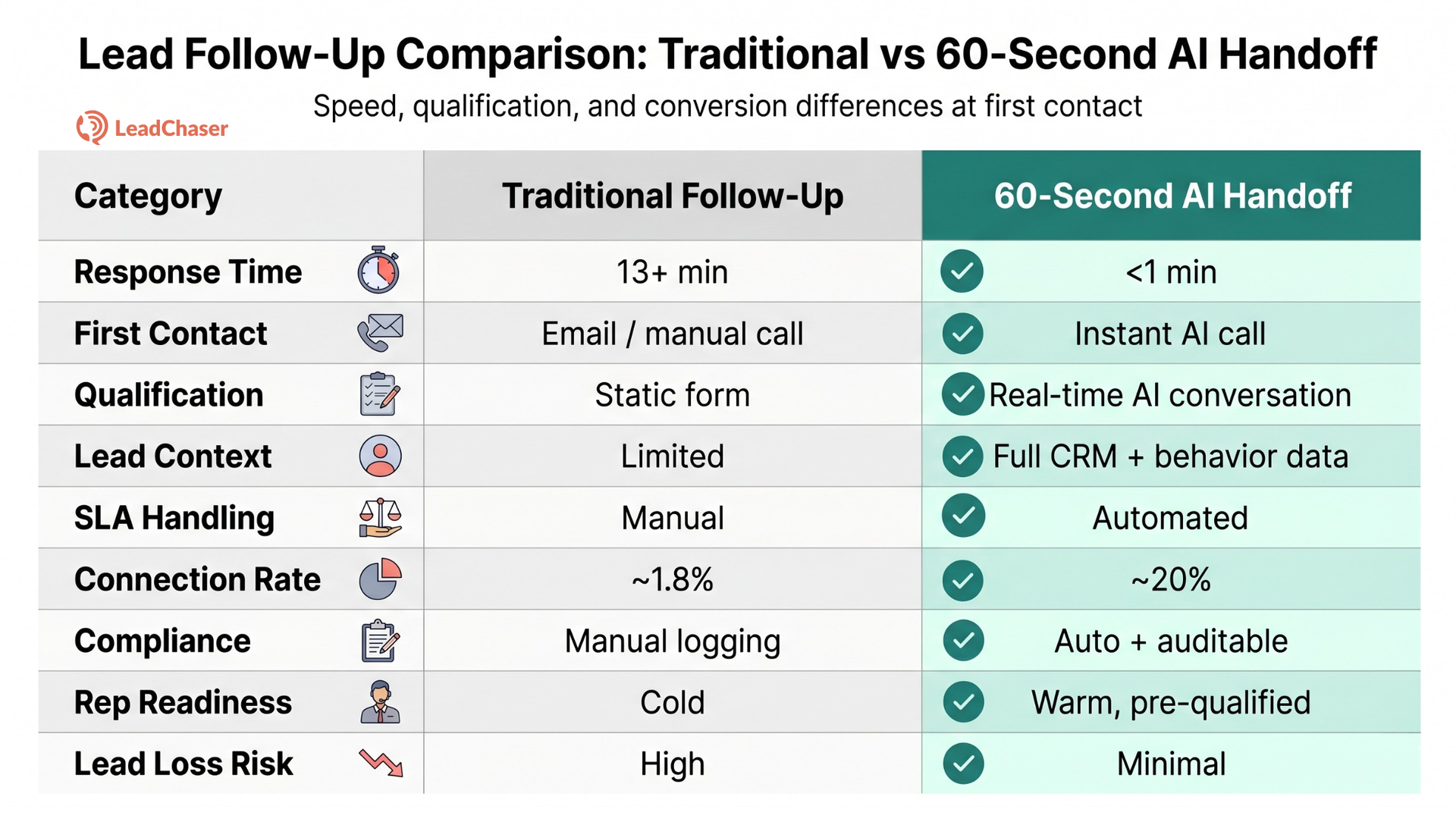
DisciplineGo around the conference table, reciting the same report multiple timesSpit out the report to the selected employee in 60 secondsTime to first contact13+ minutes (industry median, 2025)Less than 1 minuteFirst contact typeEmail autoresponder or manual dialLive outbound AI callQualification methodForm fields only (static)Conversational AI (dynamic, real-time)RepContact name and form dataFull spoken + CRM briefingSLA enforcementSupervisor-dependentAutomated escalationConnection rate~1.8% (industry baseline)~20.1% (LeadChaser case study)Compliance loggingManual or CRM-dependentAutomated, auditable records kept for 5 yearsRep's opening positionCold — no prior contextWarm, pre-qualified, context-loadedLead abandonment riskHigh (26% never respond, per Hennessey 2025)Minimal (All contacts are handled immediately by the company's AI)
Never Fear – We’ve Outlined Your Roadmap to Success!
How Should Sales Operations Teams Build and Deploy a 60-Second Handoff System?
Developing a 60-second handoff is not just about designing a system; it requires integration with many other systems, including process, compliance, and ensuring reps are ready. This checklist was developed for sales operations leaders charged with implementing a live transfer process, whether it’s establishing a new process from scratch or auditing the first iteration and improving a manual follow-up process into a 60-second handoff process of 60 seconds or less.
This checklist is also applicable to those building out a 90-second handoff process of 90 seconds or less. The checklist consists of 90 items organized into categories of Technology, Process, Compliance, and Rep Readiness. There are 30 items in each category. The items are designed to help sales operations leaders make a variety of decisions when building a live transfer process, whether it’s the first iteration or an improved version of a manual follow-up process.
**Define the Qualification Criteria (QFCs):**Determine the minimum criteria that a lead must qualify against before passing the lead to a Technology Representative for a live conversation. These criteria should include geographic, budget, timeline, and product QFCs, as well as any disqualifiers. This will serve as the foundation for creating the AI conversation script and will inform downstream routing logic. Without defined QFCs, the AI-generated decisions and processes will be arbitrary.
**Map all sources of form-submitted leads to a single system/app that will then trigger a call:**Make sure all forms (on-site, on landing pages, from paid search ads, from partners, etc.) are all submitted into one system/app (i.e., HubSpot). If leads are entering the system in different places, it can create blind spots where leads are captured, but no call is triggered.
**Set Instant Lead Calling to connect within 1 second:**Use this feature from LeadChaser, which enables an instant lead call by setting a trigger to begin the outbound dial immediately (within 1 second) based on a form submission. Measure the latency of leads coming in from primary sources and set this as a KPI, tracking the baseline time-to-first-attempt.
**Content of conversation, qualifying criteria, and qualification script:**Build your conversational AI qualification script around your defined criteria. The conversation should be short (15–20 seconds max), to the point, and purposeful. Don’t make it a sales pitch; remember, keep it brief and to the point with 2–3 qualifying questions, not an in-depth interview or discovery call.
**Use multi-variable routing, incorporating rep availability as the primary variable:**Set up your routing rules and modules to check for rep availability in real time before routing out the transfer. You waste both the lead’s time and your system’s advantage by routing to a rep who is currently engaged on another call, not to mention not providing an opportunity to work the warm transfer.
**Set up SLAs and escalation rules (with reps):**Establish timeframes before leads get escalated to the next available, qualified rep. Document those timeframes and test them before committing to full lead volume.
**PLAN COMPLIANCE PROCESS BEFORE LAUNCH:**Ensure that your communication software/platform captures all necessary consent before making an AI voice call under the FCC’s February 2024 Declaratory Ruling on the use of AI and synthetic voices for TCPA-compliant telemarketing (FCC-24-17A4.pdf). Capture opt-out data in your AI-to-human conversation, in addition to capturing call results and whether a call was transferred to sales (call transfer disposition), and retain call records for a minimum of 5 years for future reference by the FTC, in compliance with regulations effective October 15, 2024.
**Train reps on warm transfer acceptance protocol and opening scripts:**Speed is just half of the equation, since the rep receiving the warm transfer needs to understand that they are essentially entering a conversation at step five, not step one. This means the rep who accepts the warm transfer from an AI needs to understand that they are receiving a spoken briefing. They need to know how to receive that briefing quickly, confirm the prospect’s name, and then deliver an opening that references the AI-confirmed information, perhaps something other than the standard “how can I help you today?” question.
How Does Compliance Shape the Design of an AI Live Transfer System?
Compliance is often seen as an afterthought for implementing AI-powered live transfer for sales, when in reality, it is a core design element of the solution and arguably one of the key factors in achieving buyer trust with this type of technology. The landscape with regard to compliance of AI-powered voice calls has become a lot clearer since 2024, and sales teams who are looking to utilize this technology should be aware of the key factors before they launch.
A number of key developments are unfolding with regard to TCPA compliance. The biggest bullet point from a regulatory perspective is the FCC’s February 2, 2024, Declaratory Ruling on exemptions from the TCPA. That Ruling confirmed that the TCPA’s prohibition on using an “artificial or prerecorded voice” to make a call without prior express consent clearly encompasses calls made using AI to generate a human voice when such a voice is “voice cloned.” In other words, any call made to a cell phone using such technology requires prior express written consent from the called party, the same consent required for “robocalls.”
In light of the 60-second handoff ruling, collecting explicit consent to contact at the time a lead is submitted is more important than ever. Forms must explicitly inform leads that submitting a request for assistance may result in an AI-assisted or fully automated phone call and that any provided consent language must comply with the TCPA. Note, however, that collecting consent at this stage in the lead submission process is not burdensome but rather serves as a viable conversion signal. That lead has already indicated a high level of intent by submitting their information in the first place, and they are unlikely to be offended by the call.
Furthermore, it is well documented that prospects who voluntarily provide their information to a company have indicated an interest in hearing from that and/or similar companies. So long as the lead submission form accurately describes how the provided information will be used, the parties are likely to be compliant with this recent ruling. Importantly, this party has already indicated that they are open to communication with your company, which is key in this handoff timeframe. Finally, consent to contact at this stage can also serve as an alternate to the flag on active consent in the event the handoff is not completed within the 60-minute frame.
On the outbound call side, theFTC Telemarketing Sales Rulerequires that an outbound call be considered abandoned if the called party is not connected with a sales representative within 2 seconds of finishing their greeting. Our architecture for outbound calls with live transfers is geared towards meeting this requirement as long as the rep answers the transfer in a timely manner. Typically, this means within the first few rings at most. The workflow for outbound calls follows this general pattern: an AI qualifies a lead, then immediately bridges to a rep for the sale, exactly as contemplated in the FTC rule language.
The FTC recordkeeping rules go into effect on October 15, 2024, for the Telemarketing Sales Rule. As part of these rules, sellers and telemarketers must maintain call detail records for five years. These records will include information about whether a call was answered, connected, or transferred using an AI live transfer system you have in place. These records should be generated and stored within your system, and also in exportable log form in case of an audit.
Instead of building a story around AI live transfers that explains how customers get switched mid-call from AI to a live agent, the safest and most effective narrative is: “Our AI recognizes fast-qualifying leads and unqualified leads, and then a human takes over the conversation. Compliance/Tracing also captures an audit trail.” This approach ensures that the list of solutions for rapid lead engagement remains compliant while delivering value.
6 KPIs to Measure the Effectiveness of a 60-Second Handoff (SHO) for Sales Teams
Are there specific live transfer metrics that define success? I keep hearing about vendors that focus on the surface level, like self-reported completion rates or the sheer volume of transfers they claim to move, only to fall short when I look under the hood.
The KPIs for a 60-second handoff are those that measure performance across the entire process from trigger to conversational. A system that optimizes at a 1-second dial does not achieve optimization when the call is then routed to reps who are unavailable. That system is fast at the wrong thing.
The six metrics that matter most:
- **Time-to-first-attempt:**The timestamp from when a form is submitted to the first dial. This establishes your baseline speed. The target is less than 5 seconds. LeadChaser is optimized to target a 1-second start.
- **Time-to-live-human:**Form submission to prospect speaking with rep. This is what correlates with conversion, not time-to-first-attempt. Let this be measured separately from the initial time-to-first-attempt.
- **Qualification hit rate:**The percentage of your AI conversations that deserve a live transfer recommendation. This score helps you ensure that your qualification criteria are accurate. If your qualification hit rate is too low, your criteria are too strict, and you are not allowing enough conversations to reach a recommendation, then your process is too strict. If the qualification hit rate is too high, your AI is not doing enough to qualify or disqualify conversations to enable live transfers.
- Transfer acceptance rate**:**This is a measure of the percentage of warm transfers that are accepted by the receiving agent. As a general rule, if this number is below 90%, it means that there is an availability issue with your routing logic. Either your agents are not available when the routing logic transfers calls to them, or your escalation levels are too wide.
- **Abandonment at Each Stage of AI-Powered Conversational Marketing Process:**Highlight abandonment points throughout the process where leads give up, such as where leads drop off during the AI introduction, during the qualification questions, during the hold time before the lead is transferred to a representative, or after the lead has been transferred to a representative. Each abandonment point presents a unique opportunity for optimization.
- **Compliance Log Completeness:**The percentage of calls for which your solution has recorded a complete call record, including all required fields, such as consent artifact, caller ID authorization, call disposition, opt-out status, and all transfer details. 100% compliance is standard.
Frequently Asked Questions
Q1) What are the best tools for immediate follow-up after lead submission, and how do they differ from email autoresponders?
The best tools for that are AI-powered calling systems that initiate an outbound voice conversation within seconds of form submission. Unlike email sequences or SMS notifications that operate in asynchronous mode, allowing the prospect to read updates at their convenience, these tools engage the prospect in an active conversation.
A prospect answering a call from a conversational AI is in an active engagement that could quickly turn into a live sales conversation within the same minute.LeadChaser's Instant Lead Callingis designed around this model and can initiate an outbound call within 1 second of a form submission. Additionally, LeadChaser integrates with your existing CRM to ensure the speed of the first contact does not compromise the data quality of your follow-up sequences.
**
Q2) What features should I look for in top-rated AI lead routing software for sales teams?**
You should consider five key criteria: speed, routing intelligence, SLA governance, integration, and compliance. The software should make routing decisions based on real-time data from the AI conversation to qualify and route leads instantly. It should enforce SLA thresholds and automatically escalate if a transfer is missed. It should integrate with your CRM to automate the transfer of relevant data, such as qualification information, call recordings, and disposition records.
Additionally, it should maintain an auditable log of actions to ensure compliance with FTC lead-recording regulations and to support appropriate sales reporting. Finally, it should provide a spoken briefing to the rep at the moment of transfer to ensure that the opening of the live conversation is warm and context-specific. Measurable improvements in key areas such as time-to-live-human, qualification hit rate, and transfer acceptance rate can also help identify what you’re looking for.
**
Q3) How do solutions for rapid lead engagement handle leads submitted outside of business hours?**
They offer 24/7 AI-driven outbound calling. The intent window does not respect business hours, so a lead submitted at 9 PM on a Friday is just as valuable as one submitted at 10 AM on a Tuesday. In fact, in many industries, off-hours present less competition for said lead and a greater relative value of being first to respond.
These solutions are designed to operate 24/7 and use conversational AI to first connect with the lead and qualify them, then either warm-transfer to an on-call rep for high-value leads or schedule a qualified callback for the next business day with a full briefing package. The end result is that no lead goes cold before a human even connects with them.LeadChaser's platform, for example, enables automated follow-up sequences, including SMS, to engage leads well after business hours close.
**
Q4) What are the best tools for optimizing lead routing efficiency when your sales team has specialized reps covering different products or territories?**
For teams with a specialty, the best tools****are those that allow leads to be routed to multiple dimensions at the same time (e.g., both by rep name and by territory, product, and/or lead qualification profile). They handle this by implementing rules-based lead routing through a rules engine, and then, in real time, the system evaluates each qualified lead against a rep attribute matrix to determine the best available rep based on the routing rule(s).
If a lead routes to Product A in Territory B, only reps who cover that specific intersection would receive the lead, with availability as a tiebreaker. The best tools also include logic for overflow, meaning that if no specialist is available within the SLA window, the lead is routed to a qualified generalist or manager rather than letting it age.LeanData's documented case studyof SUSE achieving 100% SLA compliance shows that this type of specialty routing can be achieved in complex B2B environments.
Q5) Why is sub-second lead connection time becoming the new standard for sales teams?
The technology to achieve it exists; buyer patience has expired; and enough competing companies are pursuing lead connection times in the sub-second range that simply keeping up is no longer a competitive differentiator.
For starters, data show that most companies do not respond within five or ten minutes. A Hennessey Digital study on 2025 lead form response time found just 25% of companies respond within five minutes, with 33% responding within 10 minutes. Without automation to remove humans from the process early in the sales funnel, these sales teams are about to find out how much pain and exposure they are suffering as others implement automated lead connection times to gain a marginal edge.
Even with the fastest sales teams in the world, there are limits to follow-up. Fortunately, these teams can program their automated systems to trigger within sub-minute ranges. Already, 54% of Salesforce users report deploying AI-powered sales agents, according to data from the 2026 Salesforce State of Sales report. What does this mean for sales teams that rely on a human follow-up? They are just getting slower at a time when the rest of the market is speeding up.
Final Step: Get Your Act Together, And Remember That The 60-Second Window Is Now
While a 60-second handoff is not a formal feature offered by any vendor, it could be the paradigm shift that the sales industry needs right now. The question remains: What does it mean to your prospects when your organization decides to engage with them, and how will that signal their expectations for your relationship with them going forward? With a 60-second handoff in place, a buyer who completes a form will expect and experience an immediate, intelligent, and personalized phone call. They will not think of this as automated interaction.
Rather, they will sense that you are attending to them, and this sense of attention will be the impetus for trust. And in the end, it is trust that will ultimately facilitate their conversion.
Same information from different sources. The industry average time to respond to leads is 13 minutes. 26% of businesses never respond to their leads. 71% of consumers will give up on a shopping experience that is not relevant to them. 88% of consumers are more likely to buy from you if you are able to provide a real-time, personal experience.
No, having a lead connection answer in one second is no longer a distant ideal; it’s already possible. Today’s solutions process leads and connects the buyer to the right sales rep, qualifies the lead in real-time, and conducts a warm transfer before the sales team’s CRM has recorded the assignment. Packages for optimal****efficiency govern the trigger, qualify, route, and transfer steps, log full compliance, and enforce SLA response times, all without supervisor involvement.
The magic happens as the chain of events unfolds. At the heart of this sequence is a real human-to-human conversation empowered by AI, yet facilitated by a rep who begins to engage with the customer before the first word is ever uttered.
LeadChaseris designed to keep up with the pace to react to a form submission within seconds, not minutes. Instead of having conversations with your team about how much lost revenue there is because of latency, have them talk with prospects worth conversing with.
Works Cited
- ContactBabel.US Contact Center Decision-Makers’ Guide 2025. 2025.
- Federal Communications Commission.Declaratory Ruling on the Use of AI and Synthetic Voices for TCPA-Compliant Telemarketing. FCC-24-17A4, 2024.
- Federal Trade Commission.Complying with the Telemarketing Sales Rule. 2024,https://www.ftc.gov/business-guidance/resources/complying-telemarketing-sales-rule.
- Federal Trade Commission.Mark Your Calendars: Telemarketers & Sellers – October 15 Is Telemarketing Sales Rule’s Record Store Day. 2024,https://www.ftc.gov/business-guidance/blog/2024/10/mark-your-calendars-telemarketers-sellers-october-15-telemarketing-sales-rules-record-store-day.
- Hennessey Digital.2025 Lead Form Response Time Study. 2025,https://hennessey.com/2025-lead-form-response-time-study/.
- HubSpot.HubSpot Sales Strategy Report. 2025,https://blog.hubspot.com/sales/hubspot-sales-strategy-report.
- LeadChaser.Case Studies.https://www.leadchaser.ai/case-studies.
- LeadChaser.Features.https://www.leadchaser.ai/features.
- LeanData.2025 B2B Lead Response Time Playbook. 2025,https://www.leandata.com/wp-content/uploads/2025/06/B2B-Lead-Response-Time-Playbook-eBook-062525.pdf.
- Salesforce.State of Sales Report 2026. 2026,https://www.salesforce.com/en-us/wp-content/uploads/sites/4/documents/reports/sales/salesforce-state-of-sales-report-2026.pdf.
- Twilio.2025 State of Customer Engagement Report. 2025,https://investors.twilio.com/node/13751/pdf.