
Poor lead routing slows response times and kills momentum. This article explains how AI-driven routing evaluates intent, behavior, and availability in real time to connect leads with the best possible salesperson automatically.
Every pipeline has a golden moment, those first few minutes after a prospect raises a hand. Teams that consistently show up fast with the right rep and the right context win more deals, period. That is exactly where real-time decisioning shines. With AI lead routing, you can prioritize the hottest intent, assign the best-fitting rep instantly, and remove the busywork that slows your sellers down. The payoff: stronger conversions, higher morale, and a smoother buyer experience from the very first touch.
TL;DR
- Speed wins deals. Teams that master lead response optimization and real-time lead routing convert more because they reach buyers when intent is hottest.
- Most teams are too slow by days, not minutes. AI lead routing closes that gap so your first touch happens while interest is high.
- Smarter matching beats round-robin. With smart lead distribution, the right rep gets the right lead based on fit, availability, and context.
- Tool overload drains selling time. Consolidating around practical sales efficiency tools gives reps hours back each week.
- Getting started is straightforward. Choose AI lead routing software for sales teams that integrates with your CRM and supports your territories, SLAs, and SLG/PLG motions.
Why is speed the number-one factor in modern lead management?
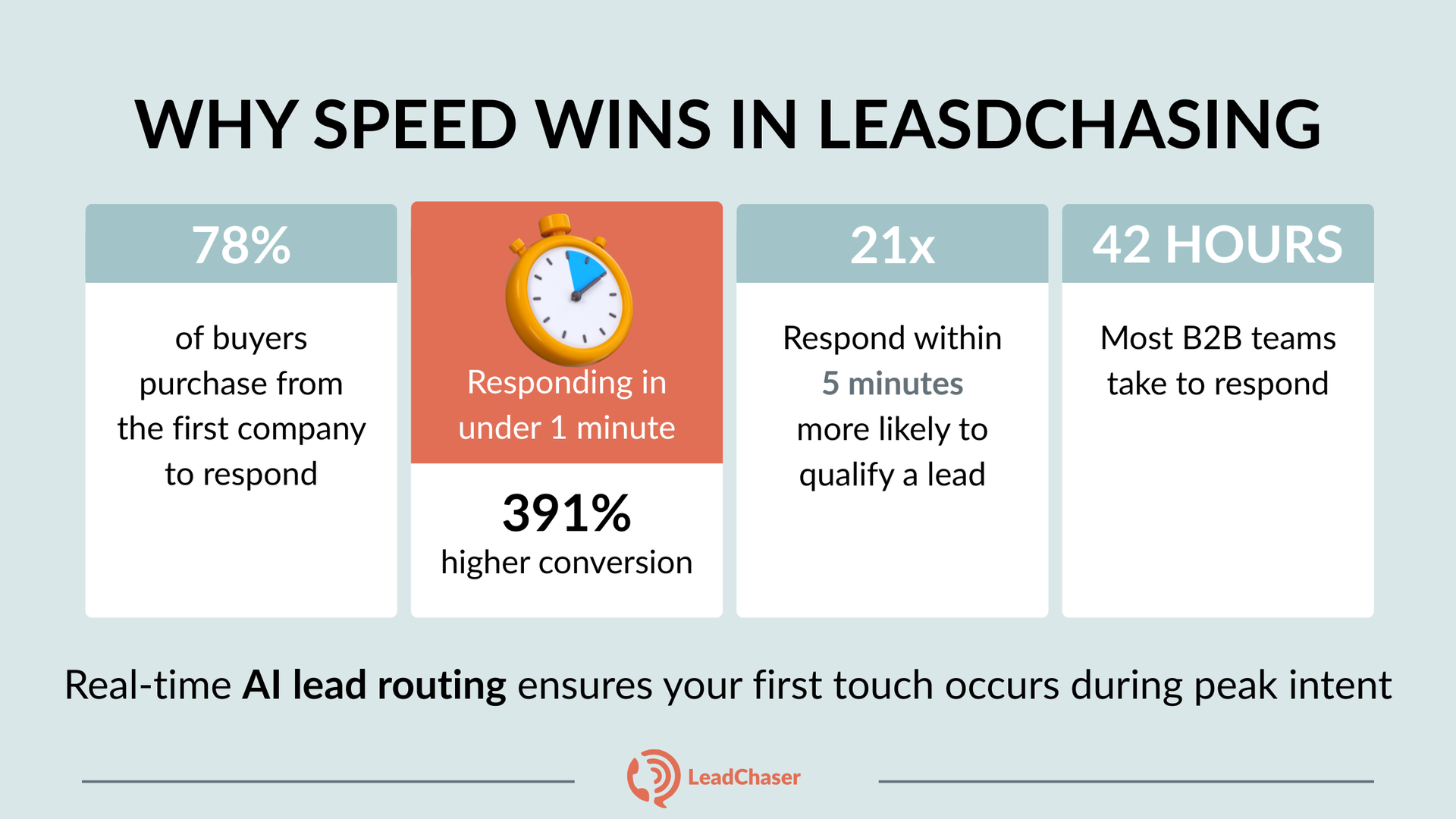
Buyers reward the fastest, most helpful response. Across B2B and PLG motions, the first company to engage often wins the business. Research shows roughly 78% of buyers purchase from the first responder, and contacting a new lead under one minute can lift conversions by around 391% (seeVendasta). Responding within five minutes makes you about 21× more likely to qualify a lead (and 100× more likely to connect) than waiting half an hour, according toKixie. That’s the heart of lead response optimization, and where real-time lead routing does its best work.
Yet most B2B teams still average about 42 hours to respond; 55% take five or more days; and only around 27% of form fills ever receive any follow-up at all (Kixie benchmarks). That delay hands opportunities to competitors. Effective AI lead routing, combined with strong lead response optimization, closes this gap by automating the handoff to the right rep instantly. In other words, real-time lead routing ensures your first touch occurs during peak intent, not after it has faded.
How does AI decide who should get the lead in real time?
It continuously re-scores each prospect based on live behavior and routes to the best-fit rep in seconds. The most effective AI lead routing systems for real-time data analysis pull signals like page views, pricing-page hits, firmographics, engagement history, and even rep calendar availability. If a high-value buyer hits your pricing page at 2:00 PM, an AI engine can alert a rep by 2:01 PM, as noted byRUH.ai. That’s the promise of real-time lead routing unlocked by AI lead routing under the hood.
- The model scores intent and fit using up-to-the-second activity.
- It checks territory, product expertise, SLAs, workload, and schedules.
- It triggers a call, task, chat, or meeting link for the best available rep.
- If no human is free, a 24/7 chatbot engages or books time immediately (perVendasta).
Because the matching logic is dynamic, not static, your assignments continue to improve as data and context change. That makes AI lead routing software for sales teams uniquely powerful: you get smart lead distribution that evolves with every interaction, reinforcing lead response optimization in the moments that matter most.
How does smarter matching convert more of your pipeline?
It assigns leads to the right specialists at the right moment, so buyers get answers fast from someone who can actually help. While round-robin can be “fair,” it’s rarely strategic. With smart lead distribution, the system weighs signals from buyer behavior and rep capability to optimize outcomes:
- **Buyer:**industry, company size, tech stack, content consumed, buying stage.
- **Context:**location, language, compliance needs, time zone.
- **Rep:**territory, product expertise, quota attainment, win rates, calendar status.
Industry experts note that AI identifies hot leads by analyzing behavior patterns and immediately assigns them to the most suitable reps (seeOrtoo). That precision is exactly what AI lead routing and smart lead distribution deliver. You reduce mismatches, avoid internal ping-pong, and give buyers a tailored first-touch experience, core to excellent lead response optimization.
What bottlenecks slow teams down, and how can AI fix them?
Tool sprawl, manual handoffs, and slow scoring create drag. AI centralizes, automates, and accelerates work. Salesforce reports that reps juggle about 10 tools to close deals, which is why 94% of companies are consolidating their toolsets. As a result, reps spend only about 28% of their week actually selling (based on data fromSalesforce research). That’s where practical sales efficiency tools and AI lead routing software for sales teams earn their keep.
Automating assignments and first touches with AI lead routing removes busywork and lag. The system monitors behavior, re-scores in the background, and triggers next steps—without a manager combing through dashboards. When you pair smart lead distribution with thoughtful lead response optimization and modern sales efficiency tools, you protect momentum and give hours back to selling.
How do teams put AI into practice without breaking workflows?
Start with clear rules, connect key systems, and launch with measurable SLAs. Keep it simple at first. The right foundation lets AI lead routing platforms for B2B companies fit your processes rather than force a reset.Below is a pragmatic rollout that many teams follow: SegmentTriggerTarget SLAChannelSMB inboundPricing page view + form< 2 minutesCall + emailMid-market inboundDemo request< 5 minutesCall + meeting linkEnterpriseRFI/contact sales< 10 minutesSenior rep call
1) Define success and SLAs
- Set response-time goals by segment (e.g., pricing-page hits under two minutes; enterprise demo requests under five minutes).
- Map “hot” signals that trigger outreach; this is a cornerstone of lead response optimization.
2) Connect your CRM and channels
- Integrate website forms, chat, ads, landing pages, and enrichment tools.
- Confirm bidirectional sync so outcomes feed into model accuracy, critical for AI lead routing systems that require real-time data analysis.
- When evaluating AI lead routing software for sales teams, prioritize turnkey integrations with Salesforce and HubSpot.
3) Build a minimal, practical routing matrix
- Start with geography, product line, and availability.
- Layer in intent signals: pricing page, high-intent content, repeat visits.
- Use skills-based assignments for complex products; that’s where real-time lead routing helps most.
4) Add safety nets and after-hours coverage
- Route late-night or weekend leads to chatbots when reps aren’t available.
- Vendasta notes bots can answer questions, qualify prospects, and set appointments in real time, so no inquiry is ignored (source).
5) Monitor, learn, and refine
- Review meetings booked, connect rates, and time-to-first-touch weekly.
- Tune routing rules and models based on closed-won patterns—not just MQL volume.
If you’re comparing options, look for AI lead routing platforms for B2B companies that handle both inbound and outbound leads, integrate with your enrichment stack, and respect territory/legal constraints. You’ll also want strong visibility and reporting so ops can measure impact. See how LeadChaser approaches this on theLeadChaser homepageandPricingpages, and browse theLeadChaser Blogfor best practices.
What results should you expect once AI is live?
Expect faster first touches, more qualified conversations, and a healthier pipeline, often within weeks. Forrester reports that companies using AI-driven scoring spend about 40% less time on unqualified leads and achieve roughly a 58% higher MQL→SQL conversion rate, translating to around a 300% first-year ROI (cited byRUH.ai). That’s a direct outcome of disciplined lead response optimization supported by AI lead routing.
Freshworks saw about 40% more meetings booked per rep after adding AI scoring to their pipeline (Artic Sledge). One midsize SaaS team tripled lead-to-opportunity conversion (from ~4% to 11%) and cut first-contact time from about eight days to two after implementing AI push-ranked lists (RUH.ai). And Gartner found companies that combine real-time digital tools with human sellers are about 1.9× more likely to beat revenue targets (Gartner).
In short, the combination of AI lead routing, smart lead distribution, and the right sales efficiency tools accelerates every step of your funnel. That’s exactly why organizations adopt AI lead routing software for sales teams and seek out AI lead routing systems for real-time data analysis, to deliver measurable gains without adding headcount.
How do you measure and improve results over time?
Track speed, quality, and efficiency, then iterate on the plays that work. Start with metrics that reveal the impact of lead response optimization enabled by real-time lead routing:
- Time-to-first-touch: minutes from form/submission to human or bot engagement
- Connect rate: first-call or first-email connect percentage
- Qualification rate: MQL→SQL conversion
- Meeting rate: percent of inbound leads that convert to meetings
- Pipeline velocity: median days from first touch to opportunity
Instrument performance by segment (SMB vs. mid-market vs. enterprise), by channel (paid search vs. organic vs. partner), and by territory. Then revise rules and weights to reinforce wins:
- Prioritize the pages and events that correlate with closed-won.
- Streamline steps where reps stall by adopting sales efficiency tools that automate follow-ups and scheduling.
- Expand coverage where you’re missing peak demand. That’s how you compound the gains of smart lead distribution.
How do geo-routing and time-zone coverage boost outcomes?
By ensuring every buyer gets a relevant, timely response in their region and language. Geo-aware AI lead routing lets you:
- Meet local SLAs by country or state, factoring in business hours and holidays.
- Route to local-language or regional specialists for better first-call resolution.
- Respect territory ownership and compliance constraints automatically.
For multinational teams, this unlocks meaningful gains. A buyer in London gets a call during their afternoon, not your night. A prospect in Toronto gets a Canadian rep who knows provincial rules. Routing with time-zone and locale awareness keeps the experience smooth, especially when paired with smart lead distribution, after-hours chatbots, and thoughtful lead response optimization.
What about data security, privacy, and compliance?
Choose trustworthy AI lead routing platforms for B2B companies that protect customer data and follow your regulatory requirements. Focus on:
- Data minimization: only the signals needed for routing and intent.
- Consent handling: clear capture for forms and chats.
- Regional processing: respect data residency where required.
- Auditability: a trail of changes and assignments for governance.
Security that matches your CRM and MAP standards keeps your team moving fast without risk. Your sales efficiency tools should help enforce policy, not work around it. Another reason to prefer mature AI lead routing software for sales teams with robust controls built in.
How do you roll this out with LeadChaser?
Keep it pragmatic: connect, configure, and iterate in tight loops. LeadChaser is built to streamline lead response optimization with real-time lead routing and smart lead distribution, while consolidating the sales efficiency tools your reps use every day.
- Connect your CRM, website, chat, enrichment, and calendar.
- Define segments, SLAs, territories, and skills. Pair your highest-intent pages to immediate outreach rules powered by AI lead routing.
- Launch a pilot on one region or product line, measure for two weeks, and expand.
Explore what this could look like for your team atLeadChaser, reviewIntegrations, comparePricing, and browse theLeadChaser Blogfor deeper guidance. If you need AI lead routing systems for real-time data analysis with enterprise-grade controls, you’ll see how the platform supports territories, SLAs, and complex rules, without adding admin overhead.
Practical checklist for faster wins
- Stand up a minimal ruleset, then let AI lead routing learn from outcomes.
- Instrument lead response optimization metrics weekly; tune with real data.
- Consolidate your sales efficiency tools so reps spend more hours selling.
- Use smart lead distribution to reduce mismatch and internal ping-pong.
- Adopt AI lead routing software for sales teams that’s turnkey with your CRM.
Key terms in action
For clarity, here’s how these concepts come together in real workflows:
- **Lead response optimization:**The operational discipline of shrinking time-to-first-touch and boosting connect/qualification rates through clear SLAs and automation.
- **Real-time lead routing:**Assigning leads instantly based on live behavior, rep availability, territories, and skills.
- **AI lead routing:**Using machine learning to score intent and fit, then trigger the best next action for the best-fit rep.
- **Smart lead distribution:**The matching logic that accounts for buyer context, compliance, and rep performance to improve outcomes.
- **Sales efficiency tools:**Scheduling, engagement, and auto-logging features that reduce admin and accelerate selling.
- **AI lead routing software for sales teams:**Platforms that integrate with CRM, support SLAs/territories, and provide analytics.
- **AI lead routing systems for real-time data analysis:**Engines that ingest live signals and update scores and assignments continuously.
- **AI lead routing platforms for B2B companies:**Enterprise-ready solutions with governance, security, and scalability across regions.
Real-world proof points
Multiple independent sources echo the same trend: when lead response optimization meets real-time lead routing, conversion leaps. Teams that deploy AI lead routing and invest in smart lead distribution not only move faster but also match better, turning more first touches into qualified meetings. And with the right sales efficiency tools, that speed translates into a pipeline you can forecast with confidence. Whether you’re vetting AI lead routing software for sales teams, modernizing your stack with AI lead routing systems for real-time data analysis, or standardizing on AI lead routing platforms for B2B companies, the evidence is clear: the approach pays off.
FAQ
Q1) What’s the difference between AI-driven assignment and rules-only routing?
Rules-only setups rely on static if/then logic, territory, round-robin, or product, regardless of buyer behavior. AI-driven assignment evaluates behavior and fit moment by moment, then routes accordingly to protect speed and quality. You keep your core rules, but the system layers in smart lead distribution so the best-fit rep gets the hottest lead right away. This is a core pattern in mature AI lead routing platforms for B2B companies and the best AI lead routing software for sales teams.
Q2) How can real-time lead routing and lead response optimization work with our existing CRM?
Modern solutions plug in natively. You connect your CRM, website, chat, calendars, and enrichment tools; define SLAs and territories; then let the engine score and assign in the background. With robust AI lead routing systems for real-time data analysis, results sync back so your model improves continuously, powering ever-faster lead response optimization.
Q3) Which teams benefit most from AI lead routing software for sales teams?
Any team handling more leads than managers can manually triage. High-growth B2B orgs, PLG motions with lots of free users, and territory-heavy enterprises benefit quickly. The combination of real-time lead routing, smart lead distribution, and practical sales efficiency tools reduces manual work and accelerates first-touch, improving qualification and meeting rates.
Q4) How do AI lead routing systems for real-time data analysis handle off-hours leads?
They can hand off to bots or virtual receptionists that engage, qualify, and book time 24/7, so no inquiry is ignored. Then, when your team comes online, the assigned rep follows up with context. This preserves lead response optimization across time zones, a major advantage for global AI lead routing platforms for B2B companies.
Q5) What should I prioritize when evaluating AI lead routing platforms for B2B companies?
Look for native CRM integrations, SLA/time-zone control, skills-based routing, auditability, security, and clear analytics. Confirm that the platform supports territories and compliance needs while enabling real-time lead routing. Above all, validate impact on time-to-first-touch and conversion, proof that the AI lead routing engine and smart lead distribution are delivering real value, not just more dashboards.
The bottom line
If you contact leads quickly with the right rep and message, you win more often. The data is consistent across sources: teams that shrink minutes, not months, capture buyer intent. AI lead routing makes that consistency possible by automating prioritization, enabling real-time lead routing, and reinforcing lead response optimization without adding headcount. When you combine smart lead distribution with practical sales efficiency tools, your reps spend more time advising and less time juggling systems. Ready to see it in action? VisitLeadChaser, and let’s map the fastest path to modern routing your team will love.
Works Cited
- Artic Sledge. “Sales Technology Trends: AI, Machine Learning, Real ROI.”Artic Sledge, 2025,https://www.articsledge.com/post/sales-technology-trends-ai-machine-learning-real-roi.
- Gartner. “Sales Leaders Must Harness the Power of AI While Keeping the Human Touch.”Gartner Newsroom, 22 May 2024,https://www.gartner.com/en/newsroom/press-releases/2024-05-22-sales-leaders-must-harness-the-power-of-ai-while-keeping-the-human-touch.
- Kixie. “Speed-to-Lead: Response Time Statistics That Drive Conversions.”Kixie Sales Blog,https://www.kixie.com/sales-blog/speed-to-lead-response-time-statistics-that-drive-conversions/.
- Ortoo. “AI-Powered Lead Assignment in Salesforce.”Ortoo Blog,https://ortooapps.com/blog/ai-powered-lead-assignment-in-salesforce/.
- RUH.ai. “AI Lead Scoring for SaaS: Complete Guide.”RUH.ai Blogs,https://www.ruh.ai/blogs/ai-lead-scoring-for-saas-complete-guide.
- Salesforce. “State of Sales Research 2023.”Salesforce News,https://www.salesforce.com/news/stories/sales-research-2023/.
- Vendasta. “Lead Response Time: Best Practices for Converting More Leads.”Vendasta Blog,https://www.vendasta.com/blog/lead-response-time/.