
Leads don’t just disappear; they stall at predictable friction points: slow response, rep mismatch, missed follow-up, and tool overload. This piece analyzes the most common pipeline leakage points and shows how AI-driven automation and routing systems eliminate revenue decay.
TL;DR
- More than 99% of B2B companies in a 2025 study failed to respond to inbound leads within five minutes, with the average personalized email arriving nearly 12 hours later, making speed-to-lead the most expensive silent cost in inbound marketing and a critical factor in conversion rate optimization.
- It takes an average of 5–7 touches to reach a prospect for the first time, meaning any sales process built on a single outreach attempt is structurally designed to lose revenue before the conversation starts, directly impacting lead scoring accuracy.
- Sales reps spend only 28% of their week actually selling, while using an average of 8 tools per deal, a combination that creates compounding latency at every handoff and follow-up stage, undermining AI automated workflow efficiency.
- 87% of sales organizations now use AI for tasks like lead scoring, prospecting, and email drafting, yet the measurable competitive gap has shifted from adoption to execution quality in sales pipeline management.
- Poor data quality costs more than a quarter of organizations over $5 million annually, and it remains the most underestimated barrier to making AI automated systems work at sales pipeline scale, directly affecting conversion rate optimization.
What Is Pipeline Leakage and Why Should You Care Right Now?
Pipeline leakage is the systematic, often invisible loss of inbound revenue at predictable friction points, not because your leads were bad, but because your sales process failed them at a moment when their intent was highest. Every hour a qualified lead waits for a response, every sequence that stops after one attempt, and every routing decision made by geography alone is a structural tax on your marketing investment. This leakage directly undermines conversion rate optimization efforts and distorts lead scoring models.
This is not a people problem. It is a systems-and-workflow problem, and the research over the last 24 months makes the failure pattern impossible to ignore. When AI automated systems are introduced into a broken sales pipeline, they merely accelerate the leakage rather than fixing it. The first step in conversion rate optimization is identifying where the sales process itself is structurally flawed.
Why is Speed-to-Lead Still Destroying Your Sales Pipeline in 2025?
Speed-to-lead remains the single highest-leverage intervention point in the entire inbound revenue model, and most teams are not close to competitive. A 2025 secret-shopper study of 114 B2B companies byWorkato's Lead Response Time Studyfound that more than 99% failed to respond within five minutes, and the average time to send a personalized email was 11 hours and 54 minutes. This delay is catastrophic for conversion rate optimization because buyer intent decays exponentially within the first few minutes.
That is not a missed SLA. That is a broken promise made to every dollar your marketing budget spent generating that lead. Nearly one in five companies never responded by email. Only 31% responded by phone, and even then, the average call-back time was 14 hours and 29 minutes. Critically, even companies that had deployed lead-routing tools averaged 3 hours and 32 minutes, which sounds better until you recognize that buyer intent at the three-hour mark is statistically far below what it was at minute two. This is why AI automated systems must be designed to intervene at the moment of intent, not hours later.
The right mental model here is risk management, not tactical optimization. If your inbound motion cannot reliably reach a prospect within minutes, your marketing spend becomes a fixed cost generating variable, and unpredictable returns. You are not running a sales pipeline. You are running a leaky bucket and measuring the water level instead of the hole. Conversion rate optimization cannot succeed in this environment because the foundational sales process is broken. Implementing lead scoring on top of this delay only compounds the problem by prioritizing leads that have already lost momentum.
Fast follow-up at the moment of intent is not a nice-to-have conversion tactic. It is the minimum viable contract between your demand generation spend and your revenue outcomes. Every hour of delay degrades that contract. When AI automated systems are introduced, they must be configured to eliminate this delay entirely. The sales pipeline must be re-engineered so that lead scoring happens in real time, and routing decisions are made within seconds, not hours. This is the only way to achieve true conversion rate optimization at scale.
Is Your Sales Process Structurally Built to Lose Leads Before the First Conversation?
The uncomfortable answer for most teams is yes, and the arithmetic explains why. Research cited byOutreach's 2025 Sales Data Analysisshows it takes an average of 5 to 7 touches to reach a contact for the first time, with nearly every prospect responding within 7 touches or fewer. If the baseline behavior is five to seven attempts, then any sales process that defaults to one outreach attempt followed by passive waiting is not just suboptimal, it is functionally designed to leak. The math is unambiguous: single-touch sequences recover, at best, a fraction of the reachable population that a properly sequenced cadence would convert.
This leakage point is particularly damaging because it is invisible in standard reporting. When a rep makes one call, sends one email, and marks the lead as unresponsive, CRM data treats that as a qualified attempt. It is not. It is an incomplete sales process presented as complete. The conversion rate optimization metrics derived from this data are therefore misleading, as they do not account for the leads that would have converted with additional touches. Lead scoring models trained on this incomplete data will also underperform, as they lack the behavioral signals that emerge only after multiple interactions.
A well-structured multi-touch cadence, phone, email, LinkedIn, voicemail, and personalized content at defined intervals, is not aggressive. It reflects how buyer communication actually works. The goal is not harassment. The goal is persistence calibrated to the statistically proven number of contacts required to create a real conversation. When AI automated systems are introduced, they must be designed to execute this cadence without human intervention. This is how you close the persistence gap at scale without burning out your team.
AtLeadChaser, the outreach architecture is built around this reality: automated sequencing that does not depend on rep memory, scheduling discipline, or manual task creation. That is how you close the persistence gap at scale without burning out your team. The sales pipeline must be re-engineered so that lead scoring happens dynamically, and follow-up sequences are triggered automatically based on prospect behavior. This is the only way to achieve a consistent conversion rate optimization in a multi-touch environment.
How Does Tool Overload Create Hidden Sales Pipeline Decay?
Tool overload does not just reduce productivity; it introduces latency into every handoff, alert, and routing decision your revenue team makes. According toSalesforce's State of Sales Statistics, sellers use an average of 8 tools to close deals, 42% of reps feel overwhelmed by this complexity, and overwhelmed sellers are 45% less likely to attain quota. That last number deserves to sit alone for a moment: 45% less likely to hit quota. This is not a morale issue. It is a mathematical drag on revenue caused by context switching, missed alerts, and broken handoffs that, on the surface, look like "lead quality problems."
Here is the mechanism: when a rep is managing 8 tools, there is no single source of truth. An alert fires in one platform. The routing decision is logged elsewhere. The follow-up task lives in a third. The enrichment data sits in a fourth. The result is what operations leaders sometimes call "swivel-chair leakage", the invisible sales pipeline decay that occurs in the space between tools, not inside any of them. This fragmentation directly undermines conversion rate optimization because critical signals are lost in the handoffs. Lead scoring models that rely on behavioral data will also fail if the data is scattered across multiple systems.
Salesforce also reports that 84% of teams without an all-in-one platform are actively planning to consolidate their tech stack. That is not consolidation for its own sake. It is a recognition that fragmented tooling has become a structural barrier to executing a coherent sales process. When AI automated systems are introduced into this environment, they often exacerbate the problem by adding yet another tool to the mix. The solution is not to add more tools but to unify the existing ones under a single workflow engine that can execute routing, enrichment, and follow-up without human intervention.
The fix is not simply fewer tools; it is unified workflow execution. When routing, enrichment, sequencing, CRM updates, and reporting all operate from the same data layer, the latency between intent and action shrinks from hours to seconds. This is the only way to achieve true conversion rate optimization in a multi-tool environment. The sales pipeline must be designed so that lead scoring happens in real time, and routing decisions are made based on a complete, unified dataset. AI automated systems can then operate on this unified data layer, eliminating the latency that currently plagues most revenue teams.
Why is Admin Burden One of the Most Underrated Sales Pipeline Problems?
Admin burden is not a morale complaint; it is a capacity constraint that directly limits how many qualified leads receive real human attention. Salesforce reports that sales reps spend only28% of their week actually selling, with the remaining 72% consumed by administrative tasks, data entry, meeting preparation, internal coordination, and other non-revenue work. When you frame this as a sales pipeline problem rather than a time management problem, the implications are immediate. Every manual step you add to an inbound workflow, copy-pasting a form submission into a CRM, manually enriching a record, building a sequence by hand, sending assignment notifications through Slack, is consuming capacity from a pool that is already allocated at only 28%.
The compound effect is severe. A rep who spends 30 minutes processing a single inbound lead before making the first contact has eliminated the speed advantage that made that lead valuable in the first place. They have also reduced the number of leads they can touch that day, compressed their follow-up bandwidth, and introduced human error at every transfer point. This directly undermines conversion rate optimization because the sales process is now bottlenecked by administrative overhead. Lead scoring models that rely on manual data entry will also be inaccurate, as the data is often incomplete or outdated by the time it is entered.
This is the environment in which AI automated workflows produce their most immediate return: not by replacing seller judgment, but by eliminating the administrative scaffolding that surrounds every revenue-generating action. When CRM updates, enrichment, routing, and initial outreach happen automatically, the 28% of selling time becomes genuinely productive rather than partially consumed by setup. The sales pipeline must be re-engineered so that lead scoring happens at the point of intake, and routing decisions are made without human intervention. This is the only way to achieve true conversion rate optimization at scale, as it eliminates the latency that currently plagues most revenue teams.
What Does Poor Data Quality Actually Cost Your Revenue Operations?
Poor data quality is both a direct revenue loss and the primary reason AI automated systems underperform or fail entirely. IBM's research on thecost of poor data qualityshows that more than a quarter of organizations estimate they lose more than $5 million annually due to data integrity issues, and 7% report losses exceeding $25 million. These numbers represent only the costs organizations can measure. The more insidious cost is invisible: bad routing decisions made from stale enrichment data, lead scoring models trained on duplicate records, and personalization that fails because the CRM holds contradictory or incomplete information.
Here is the critical nuance for RevOps and AI automated strategy: a chatbot or AI automated system applied to a corrupted data environment does not fix sales pipeline leakage. It accelerates it. Wrong data means wrong routing. Wrong routing means the wrong rep receives the lead. Wrong rep means a conversation that never develops. And none of this shows up in your AI automated performance dashboard, it shows up as bad conversion rate optimization outcomes three months later when someone finally asks why the ICP match score is meaningless.
The correct framing for any AI automated deployment in revenue operations is: AI automated plus data hygiene plus workflow design. Prioritize them in that order of dependency, not that order of excitement. The sales process must be built on a foundation of clean, real-time data. Lead scoring models must be trained on this data, and routing decisions must be made based on it. Only then can conversion rate optimization efforts succeed. Without this foundation, AI automated systems will merely accelerate the leakage already present in the sales pipeline.
How Does AI Automated Solve Response Latency — and Where Does It Actually Work?
AI automated engagement eliminates response latency by removing human dependency from the first touch. Instead of waiting for a rep to log in, check the queue, read the record, and compose a message, an AI automated system can trigger a personalized call, text, or email within seconds of a form submission, at any hour, on any day. This is the only way to achieve true conversion rate optimization in a high-velocity inbound environment.
The Workato benchmark makes the opportunity concrete: the average personalized email response time across tested B2B companies was 11 hours and 54 minutes. An AI automated system operating on real-time webhook triggers can compress that to under 60 seconds without requiring any human action. This is not automation as a substitute for relationship-building. It is automation as a bridge to the moment when relationship-building becomes possible. The AI automated response acknowledges intent, confirms next steps, and either books a meeting or surfaces the lead for human follow-up, all before a competitor's rep has checked their morning queue.
Salesforce's 2026 State of Sales data reinforces the scale of what this makes possible. AI automated agents in one internal case study contacted 130,000 leads and created 3,200 opportunities in four months by systematically working previously untouched leads, the "sawdust" that human teams never had the capacity to process. That is not a marginal improvement. That is a new revenue stream recovered from existing demand. This is how conversion rate optimization succeeds at scale: by ensuring that no lead is left untouched due to human latency.
For teams evaluating how to structure this capability,LeadChaser's AI automated outreach platformis built specifically around this use case: instant engagement at the moment of intent, with routing logic that hands off to the right human at the right time. The sales pipeline must be designed so that lead scoring happens in real time, and routing decisions are made within seconds. This is the only way to achieve true conversion rate optimization in a high-velocity environment. Without AI automated systems, the sales process will continue to leak revenue at every stage.
What Is Context-Aware Routing and Why Does It Eliminate Rep Mismatch Leakage?
Context-aware routing is the practice of assigning inbound leads based on a combination of account attributes, behavioral signals, and real-time rep capacity, rather than geography, alphabetical order, or round-robin defaults. It eliminates rep-mismatch leakage because routing decisions are made with full context rather than arbitrary rules. This is critical for conversion rate optimization because the right rep at the right time can make the difference between a closed deal and a lost opportunity.
The Workato data clearly exposes the failure of rule-based routing: even organizations that had deployed lead-routing tools still averaged 3 hours and 32 minutes to respond. The tooling existed; the execution quality did not. That gap is created by routing logic that ignores capacity, assigns to unavailable reps, and lacks an auto-escalation path when an SLA breach becomes imminent. This directly undermines lead scoring efforts because the score is meaningless if the lead is not routed to the right rep. The sales pipeline must be designed so that routing decisions are made based on real-time data, not static rules.
A properly designed context-aware routing system operates on three layers simultaneously. The first is account-level attributes: industry vertical, employee count, revenue band, and geographic territory. The second is the intent signal: a demo request carries different urgency and rep-fit requirements than a content download. The third is rep capacity: current open opportunities, SLA load, and scheduled availability determine whether a specific assignment will actually receive a timely response. This is how AI automated systems can eliminate rep-mismatch leakage entirely.
When all three layers operate in real time, routing stops being a source of sales pipeline leakage and becomes a revenue multiplier. The right lead reaches the right rep with the context needed for a qualified first conversation, not a generic introduction. This is the only way to achieve true conversion rate optimization at scale. For teams building this architecture, the auto-escalation logic is equally important. When an SLA breach is imminent, the system should automatically re-route, notify the manager, and trigger an AI automated follow-up to preserve the lead's engagement while the human handoff resolves. The sales process must be designed to handle these edge cases without human intervention.
How Should AI Automated Persistence Work to Recover the 5–7 Touch Gap?
AI automated persistence works by treating multi-touch sequencing as a systematic, data-driven process rather than as rep-dependent behavior. Because reaching a prospect reliably requires an average of 5 to 7 touches, any outreach system that cannot guarantee consistent execution across that full sequence will structurally underperform. This is why conversion rate optimization efforts often fail: the sales process is not designed to execute the full cadence required to convert leads.
According toOutreach's 2025 research, nearly every contact responds within 7 touches or fewer, and sometimes as few as 3. This means the population of leads your team classifies as "unresponsive" after one or two attempts contains a substantial number of prospects who would have responded on touch four or five if the sequence had continued. Lead scoring models that do not account for this behavior will underperform, as they lack the signals that emerge only after multiple interactions.
AI automated persistence eliminates dependence on rep memory and scheduling discipline, making consistent multi-touch execution nearly impossible at scale. Sequences are triggered automatically, personalized dynamically based on lead behavior and enrichment data, and paused or redirected when a response is detected. The system does not forget. It does not deprioritize. It does not run out of bandwidth. This is how AI automated systems can recover the 5–7 touch gap entirely without human intervention.
The measurable output of this capability appears directly in conversion rate optimization outcomes: higher conversion rates, shorter time-to-first-conversation, and lower cost per qualified meeting. Teams that implement AI automated sequencing consistently recover a material portion of the leads that manual processes abandoned within the first two touches. The sales pipeline must be designed so that lead scoring happens dynamically, and sequences are triggered automatically based on prospect behavior. This is the only way to achieve true conversion rate optimization in a multi-touch environment.
Comparison Table: Manual Sales Pipeline Execution vs. AI Automated Pipeline Execution
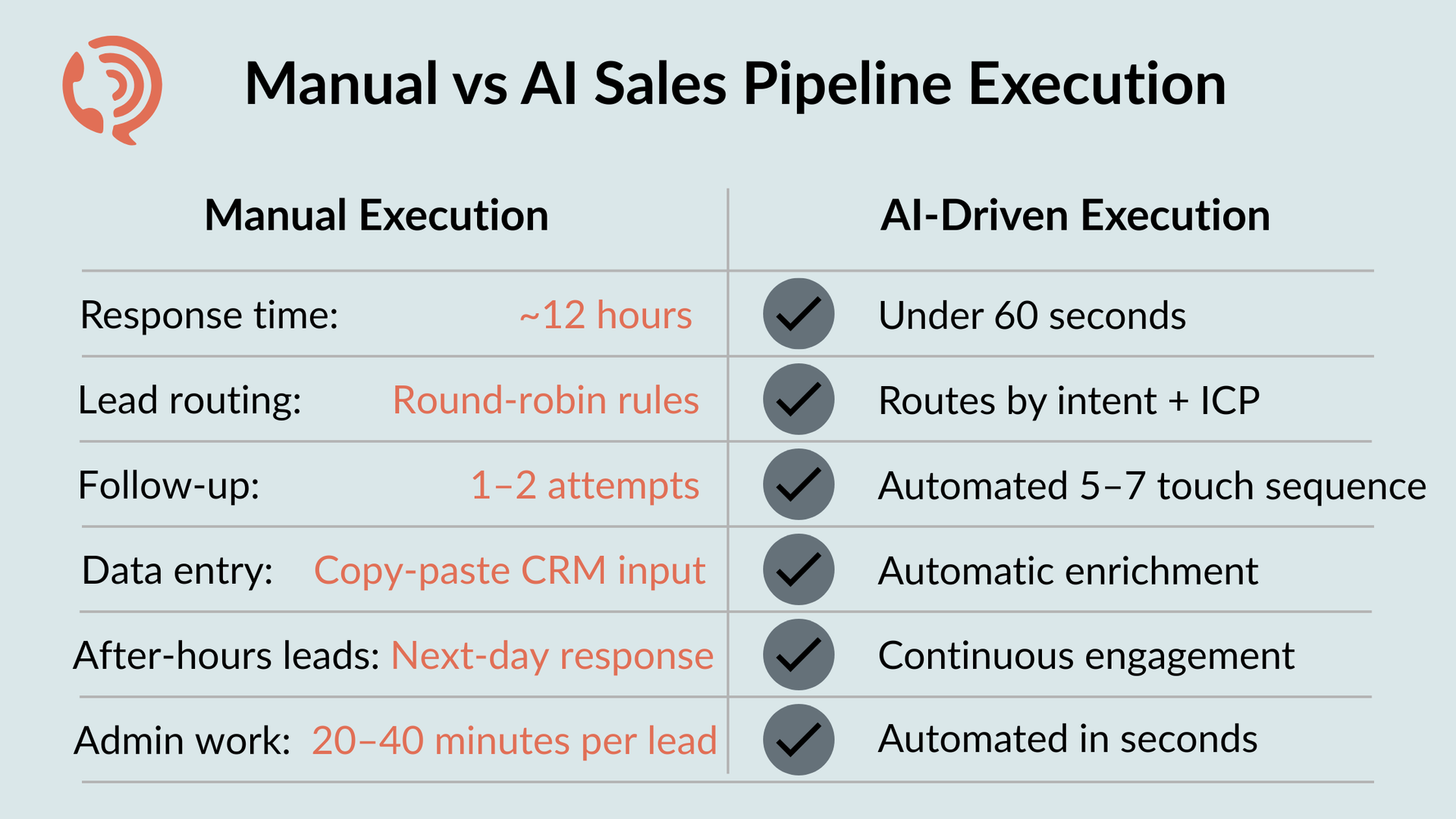
Pipeline StageManual ExecutionAI-Driven ExecutionRevenue ImpactFirst Response Time11 hours 54 minutes averageUnder 60 seconds via an AI automated triggerPreserves peak buyer intentLead Routing LogicTerritory or round-robin rulesICP + intent + rep capacity in real timeEliminates rep mismatch leakageFollow-Up Persistence1–2 attempts, rep-dependent5–7+ touch sequences, automatically executedRecovers 3–5 additional contact opportunities per leadCRM Data EntryManual copy-paste, high error rateAuto-populated from enrichment at intakeEnables accurate lead scoring modelsLead Scoring InputsStatic scoring on form fields aloneDynamic scoring on behavioral signals + firmographicsImproves sales pipeline prioritization accuracyAfter-Hours CoverageNo response until business hoursContinuous AI automated engagementCaptures after-hours intent at full valueAdmin Time Per Lead20–40 minutes of setup per inbound recordSeconds, fully automated workflowUnlocks capacity within the 28% selling windowSequence Completion RateLow — rep discretion determines follow-throughHigh — system-enforced completionDirectly improves conversion rate optimizationData Quality at RoutingDependent on manual enrichmentAutomated enrichment at the point of intakeRemoves bad-data routing errorsReporting AccuracyFragmented across 8 tools on averageUnified dashboard from a single data layerEnables accurate sales pipeline forecasting
How Do AI Automated Adoption Statistics Actually Reveal Where Sales Pipeline Leakage Persists?
The AI automated adoption numbers contain an important contradiction worth understanding before designing your revenue operations strategy. Salesforce's 2026 State of Sales report shows that87% of sales organizations now use AIfor tasks like prospecting, forecasting, lead scoring, and email drafting. At the same time, the U.S. Census Bureau'sBusiness Trends and Outlook Survey from May 2025found that only approximately 10% of businesses use AI to produce goods and services, up from 5.4% in February 2024.
Both numbers are accurate, and reconciling them reveals exactly where sales pipeline leakage continues to concentrate. The 87% figure represents employee-level AI automated usage: individual reps using AI tools to draft messages, summarize calls, or run searches. The 10% figure represents AI automated embedded in production workflows, systematic, measurable automation that operates without human initiation on every transaction. That gap, between employees using AI and AI running in production workflows, is precisely where the remaining sales pipeline leakage lives.
A rep who uses an AI automated tool to draft a follow-up email is still subject to the delay of opening the tool, reviewing the draft, and sending it manually. A production workflow that triggers an AI automated response in seconds eliminates human delay entirely. This is why conversion rate optimization efforts often fail: the sales process is not designed to leverage AI automated systems at scale. The Stanford 2025 AI Index confirms the macro direction: 78% of organizations reported using AI in 2024, up from 55% in 2023. The competitive question for revenue teams has therefore shifted from "are we using AI?" to "is our AI automated, wired into routing, sequencing, SLAs, and CRM updates in a way that eliminates human-delay leakage?"
HubSpot's 2025 survey adds that 84% of reps say AI saves time and optimizes processes, 83% say it personalizes interactions, and 82% say it surfaces better insights from data. Only 8% report not using AI at all. The infrastructure is in place. The execution quality is where differentiation now lives. The sales pipeline must be re-engineered so that lead scoring happens in real time, and routing decisions are made without human intervention. This is the only way to achieve true conversion rate optimization at scale.
What is the Complete lead scoring Framework That Stops AI Automated from Routing Garbage?
Effective lead scoring at the AI automated execution layer requires inputs from three distinct data categories working simultaneously. Without all three, lead scoring produces prioritization that looks accurate in dashboards and fails in practice. This is why many conversion rate optimization efforts fail: the lead scoring model is incomplete.
The first category is firmographic data: company size, industry vertical, revenue band, technology stack, and geographic region. These attributes determine whether a lead fits the ideal customer profile at the account level and determine which routing path applies. The second category is behavioral signals: page visits, content consumption patterns, email engagement, demo requests, pricing page views, and return visit frequency. Behavioral signals indicate where a prospect is in the decision journey and how urgent their engagement is relative to other leads in the queue. The third category is contextual completeness: whether the record has sufficient data to make a routing decision without human intervention. A lead scoring model applied to an incomplete record will score gaps rather than the signal, leading to routing decisions based on absence rather than presence.
IBM's data on the financial impact of data quality, over $5 million in annual losses for more than a quarter of organizations, is not primarily a data governance story. It is a lead scoring story. Every duplicate record, every missing enrichment field, and every stale job title in your CRM is a miscalibrated input into the model that determines which rep calls which lead at which priority. The downstream revenue effect is compounding. This is why AI automated systems must be built on a foundation of clean, real-time data. The sales pipeline must be designed so that lead scoring happens dynamically, and routing decisions are made based on complete, accurate data.
The lead scoring framework that works at an AI automated scale has four operational requirements: it updates dynamically as behavior changes; it degrades leads that go cold rather than holding static scores indefinitely; it integrates firmographic and behavioral inputs on the same record; and it triggers routing actions directly rather than requiring human review before execution. This is the only way to achieve true conversion rate optimization at scale. Without this framework, AI automated systems will merely accelerate the leakage already present in the sales process.
How Should You Govern AI Automated Outreach Without Creating New Risk?
Deploying AI automated systems in customer-facing revenue workflows requires a governance layer that senior revenue and operations leaders often overlook amid the urgency of implementation. The NISTAI Risk Management Framework for Generative AIprovides a structured foundation for thinking about monitoring, evaluation, transparency, and safety controls in AI automated systems.
For revenue teams, governance is not abstract compliance. It is practical risk management. An AI automated system that sends incorrect personalization, a wrong company name, an outdated title, or irrelevant context does not just fail to convert. It damages the brand relationship with a prospect who had expressed genuine intent. The cost is not just a lost lead. It is a degraded future opportunity. This is why conversion rate optimization efforts must include governance controls to ensure that AI automated systems operate within defined parameters.
The governance framework for AI automated outreach in sales comprises five practical components. First, output monitoring: every AI-generated message should be sampled for accuracy, tone consistency, and personalization quality at a regular cadence. Second, escalation paths: the system must know when to surface a lead to a human rather than continuing automation, particularly when sentiment signals go negative. Third, data refresh intervals: enrichment data used for personalization should have a defined expiration after which re-enrichment is triggered automatically. Fourth, performance attribution: conversion rate optimization outcomes from AI automated sequences should be tracked separately from human-initiated outreach to understand the true impact of each. Fifth, override controls: reps and managers must have immediate authority to pause, modify, or redirect AI automated sequences without IT intervention.
These governance controls do not slow AI automated revenue workflows. They make the outputs trustworthy enough to run at scale without requiring constant human oversight. The sales pipeline must be designed so that lead scoring happens in real time, and routing decisions are made based on complete, accurate data. Governance ensures that these decisions are executed safely and effectively, without introducing new risks into the sales process.
FAQ
Q1) What are the best tools for optimizing lead routing efficiency in a high-velocity sales pipeline?
The best tools for optimizing lead routing efficiency combine real-time data enrichment, context-aware routing logic, and AI-driven follow-up. Platforms likeLeadChaserintegrate with your CRM to route leads based on firmographic data, behavioral signals, and rep capacity, ensuring that the right lead reaches the right rep at the right time. This eliminates rep-mismatch leakage and directly improves conversion rate optimization outcomes. Other top-rated tools include Outreach for sequencing, Salesforce for CRM integration, and HubSpot for inbound lead management. The key is to select a tool that unifies routing, enrichment, and follow-up into a single workflow, rather than adding another fragmented system to your tech stack.
For teams focused on lead scoring, tools that offer dynamic scoring based on real-time behavioral data are essential. This ensures that lead scoring models remain accurate even as prospect behavior changes. The best tools also provide auto-escalation paths for SLA breaches, ensuring that no lead falls through the cracks. When evaluating tools, prioritize those that integrate seamlessly with your existing sales process and can execute AI automated workflows without human intervention.
**Q2) What are the top-rated AI lead routing platforms for sales teams? **
Enterprise sales teams require AI automated lead routing platforms that can handle high volumes of inbound leads while maintaining accuracy and speed. Top-rated platforms likeLeadChaser, Outreach, and Salesloft offer advanced routing logic that combines firmographic data, behavioral signals, and rep capacity to ensure optimal lead distribution. These platforms also provide AI automated follow-up sequences, ensuring that no lead is left untouched due to human latency.
For enterprise teams, the most effective platforms integrate with existing CRM systems and can scale to handle thousands of leads per day. They should also offer robust lead scoring capabilities, allowing teams to prioritize leads based on real-time data. The best platforms also include governance controls to ensure that AI automated outreach remains accurate and compliant with brand standards. When selecting a platform, prioritize those that offer unified workflow execution, eliminating the latency that currently plagues most enterprise sales pipelines.
Enterprise teams should also look for platforms that provide detailed analytics and reporting, allowing them to track conversion rate optimization outcomes and identify areas for improvement. The best platforms offer real-time dashboards that provide visibility into routing decisions, follow-up sequences, and rep performance. This ensures that the sales process remains transparent and accountable, even when AI automated systems are handling the bulk of the workflow.
Q3) What are the best analytical tools for tracking pipeline performance and identifying leakage points?
The best analytical tools for tracking sales pipeline performance combine real-time data visualization, predictive analytics, and leakage detection capabilities. Platforms like Salesforce, HubSpot, and Clari offer advanced dashboards that provide visibility into every stage of the sales process, from lead intake to deal closure. These tools allow teams to identify leakage points by tracking conversion rates at each stage and comparing them to industry benchmarks.
For teams focused on conversion rate optimization, predictive analytics tools are particularly valuable. These tools use historical data to forecast future performance, allowing teams to proactively address potential leakage points before they become critical. The best tools also integrate with AI automated systems, ensuring that routing decisions and follow-up sequences are based on real-time data. This is essential for maintaining accuracy in lead scoring models and ensuring that the sales pipeline operates at peak efficiency.
When evaluating analytical tools, prioritize those that offer customizable dashboards and reporting capabilities. This allows teams to tailor the tool to their specific sales process and focus on the metrics that matter most. The best tools also integrate with other systems, ensuring data is unified and accurate. This is critical for teams that rely on AI automated systems to execute their workflows, as fragmented data can lead to inaccurate routing decisions and missed
opportunities.
Q4) How can AI automated systems improve lead scoring accuracy and reduce rep mismatch leakage?
AI automated systems improve lead scoring accuracy by integrating real-time behavioral data with firmographic attributes, ensuring scores reflect the most current prospect behavior. Traditional lead scoring models often rely on static data, such as form fields or outdated enrichment, which can lead to inaccurate prioritization. AI automated systems, on the other hand, continuously update scores based on prospect interactions, ensuring that the most engaged leads are prioritized.
To reduce rep-mismatch leakage, AI automated systems use context-aware routing logic that considers rep capacity, expertise, and availability. This ensures that leads are routed to the right rep at the right time, eliminating the delays and mismatches that currently plague most sales pipelines. The best AI-driven systems also include auto-escalation paths for SLA breaches, ensuring no lead falls through the cracks. This directly improves conversion rate optimization outcomes by ensuring that every lead receives timely, relevant follow-up.
The key to improving lead scoring accuracy with AI automated systems is to ensure that the data used for scoring is clean, complete, and up-to-date. This requires a robust data hygiene process and integration with enrichment tools that provide real-time firmographic and behavioral data. The sales process must be designed to support this data flow, ensuring that lead scoring happens dynamically and routing decisions are made based on accurate, real-time data.
Q5) What are the key metrics to monitor for conversion rate optimization in an AI automated sales pipeline?
The key metrics to monitor for conversion rate optimization in an AI automated sales pipeline include response time, follow-up persistence, rep mismatch rate, and data quality. Response time is critical because buyer intent decays exponentially after the first few minutes. Teams should monitor the average time to first response and the percentage of leads that receive a response within 5 minutes. This is the most direct measure of an AI automated system's effectiveness.
Follow-up persistence is another critical metric, as it measures the percentage of leads that receive the full 5–7 touch sequence required to convert. Teams should track the completion rate of AI-automated sequences and the number of touches required to elicit a response. This ensures that the sales process is executing the full cadence required for conversion rate optimization.
Rep-mismatch rate measures the percentage of leads routed to the wrong rep due to incorrect lead scoring or outdated routing logic. This metric is critical for identifying leakage points in the sales pipeline. Teams should also monitor data quality, as poor data can lead to inaccurate lead scoring and routing decisions. The best AI-driven systems include data hygiene checks to ensure enrichment data is accurate and up-to-date.
Finally, teams should monitor the overall conversion rate optimization outcomes, including the percentage of leads that convert to opportunities and the percentage of opportunities that close. These metrics provide a holistic view of sales pipeline performance and help teams identify areas for improvement. The best analytical tools provide real-time dashboards that track these metrics, allowing teams to make data-driven decisions and continuously optimize their sales process.
Works Cited
IBM. "The Cost of Poor Data Quality."IBM Think Insights, 2023,www.ibm.com/think/insights/cost-of-poor-data-quality.
NIST. "Artificial Intelligence Risk Management Framework: Generative Artificial Intelligence."National Institute of Standards and Technology, 2024,www.nist.gov/publications/artificial-intelligence-risk-management-framework-generative-artificial-intelligence.
Outreach. "Sales 2025 Data Analysis."Outreach Blog, 2025,www.outreach.io/resources/blog/sales-2025-data-analysis.
Salesforce. "State of Sales Statistics."Salesforce, 2025,www.salesforce.com/sales/state-of-sales/sales-statistics/.
Salesforce. "State of Sales Trends."Salesforce, 2025,www.salesforce.com/ap/sales/state-of-sales/sales-trends/.
Salesforce. "State of Sales Report: AI Agents Stats."Salesforce News, 2026,www.salesforce.com/news/stories/state-of-sales-report-announcement-2026/ai-agents-stats/.
Stanford University. "2025 AI Index Report."Stanford HAI, 2025,hai.stanford.edu/ai-index/2025-ai-index-report.
U.S. Census Bureau. "Business Trends and Outlook Survey, May 2025."U.S. Census Bureau, 2025,www.census.gov/about/history/stories/monthly/2025/july-2025.html.
Workato. "Lead Response Time Study."Workato The Connector, 2025,www.workato.com/the-connector/lead-response-time-study/.