
Not all leads are equal. This blog explores high-intent digital behaviors, pricing page revisits, repeat sessions, late-night demo requests, and content stacking, and explains how AI can detect, score, and trigger instant engagement before competitors react.
TL;DR
- According to6sense's 2025 B2B Buyer Experience Report, 94% of buying groups rank their vendor shortlist before speaking to a single sales rep, and the vendor contacted first wins approximately 8 out of 10 deals.
- Salesforce's State of Sales Report (2025)found that 87% of sales organizations now use AI in some form, and AI agents contacted 130,000 leads and created 3,200 opportunities in just four months at one internal deployment.
- Zendesk's CX Trends 2026 researchreveals that 74% of consumers now expect 24/7 service availability due to AI, and 86% say responsiveness directly influences their purchase decisions.
- McKinsey's 2024 B2B Pulse Surveyfound that B2B buyers now use approximately 10 interaction channels, up from five in 2016, indicating that intent signals are scattered across more touchpoints than most teams monitor.
- The average B2B buying cycle dropped from 11.3 months in 2024 to 10.1 months in 2025, compressing the window between when a buyer first shows interest and when they make a decision, which means delayed outreach is no longer a minor inefficiency; it is a structural loss.
Why Are So Many High-Intent Leads Going Uncontacted?
The problem is not that your pipeline is empty. The problem is that your pipeline is full of buyers who have already decided, and you are not the vendor they decided on.
This is the core paradox of modern B2B selling: buyers are moving faster, engaging earlier, and leaving more digital signals than at any previous point in the history of sales. Yet most revenue teams still treat those signals as inputs to a weekly review cycle rather than as triggers for immediate action.
Understanding which behaviors indicate a buying group in motion, and what to do within minutes of detecting them, is the difference between being the vendor that wins and the vendor that gets a polite "we went another direction" email three weeks from now.
This blog is not about building better lead nurturing sequences. It is about recognizing the specific moments when a lead stops being a lead and becomes an active buyer, and engineering your response infrastructure so you act before your competitors even load their CRM. The integration of AI lead generation tools has become essential in this process, as they enable real-time detection and response to these critical signals.
What Has Actually Changed in the Last Two Years That Makes This So Urgent?
Has the B2B Buying Journey Really Gotten That Much Faster?
Yes, and the compression is more dramatic than most sales teams have adjusted for. The6sense 2025 B2B Buyer Experience Reporttracked approximately 4,000 B2B buyers and found that the average buying cycle dropped from 11.3 months to 10.1 months in a single year, a reduction of more than six weeks. The point of first contact shifted from 69% of the way through the journey to 61%, indicating buyers are reaching out roughly six to seven weeks earlier than in 2024.
That sounds like good news for sellers. Buyers are more accessible. Except the same study found that 4 out of 5 deals are still won by the vendor the buyer had already mentally pre-selected before making contact. Buyers are not reaching out because they are open-minded and exploring. They are reaching out to validate a decision they have already made internally.
The implication is uncomfortable: by the time a buyer fills out your demo form or sends an inquiry email, the race is often already over. Your only real competitive window is in the signals that come before that form submission, the pricing page revisits, the late-night sessions, the repeat documentation reads, and the content stacks that indicate a buying group doing distributed research.
This is where AI lead generation platforms like LeadChaser become operationally essential, not just convenient. If you cannot detect and act on pre-contact signals in real time, you are perpetually competing for deals that have already been decided. Implementing effective customer retention strategies also requires recognizing these signals early to maintain engagement with existing clients who may be evaluating alternatives.
Is the Omnichannel Signal Problem as Serious as People Say?
It is more serious than most teams realize, because the fragmentation is accelerating.McKinsey's 2024 B2B Pulse Survey, conducted among nearly 4,000 B2B decision makers, found that buyers now use approximately 10 distinct interaction channels across a single purchase journey, up from 5 in 2016. That means the behavioral evidence of a buyer in motion is twice as fragmented as it was less than a decade ago.
More critically, more than half of those surveyed indicated they were likely to switch suppliers if the cross-channel experience was not smooth. That is a direct signal that AI lead generation systems, which cannot unify behavioral data across channels, are not just missing signals; they are actively creating friction that hands a competitive advantage to whoever responds faster and more contextually.
Teams running effective behavior analytic frameworks are not looking at a single channel. They are aggregating web sessions, content downloads, ad engagement, co-op intent data, CRM history, and email interaction patterns into a single account-level view. That unified view is what makes a trigger meaningful rather than noisy. These behavior analytic systems are crucial for identifying patterns indicating a buyer's readiness to purchase, enabling timely, targeted automated messages that can significantly improve conversion rates.
Which High-Intent Signals Are Most Commonly Ignored?
What Does a Pricing Page Revisit Actually Mean?
A second or third visit to your pricing page within a short window is one of the highest-intent signals a digital buyer can generate, and most teams respond to it by adding the contact to a generic email sequence. That response is wrong.
When a buyer returns to your pricing page, especially when that visit is accompanied by comparison behavior, time-on-page above the median, or navigation to a plan-specific FAQ, it almost always means that internal budget alignment is underway. Someone on the buying group is building the business case or preparing to answer the question, "Can we afford this, and is it worth switching?" That is not a top-of-funnel moment. That is a pre-close moment.
According to6sense's buyer research, 94% of buying groups rank their vendor shortlist before engaging sellers. When someone revisits your pricing page, they are likely justifying you as number one or finding the reason to drop you from the list entirely. Your job is to show up with the right information before they make that judgment without you in the room.
The correct response to a second pricing page visit within seven days is immediate, human-calibrated outreach: "I noticed you've been looking at our plans. I'd like to help map the right option to your specific situation. Can I send you a one-page cost breakdown or a quick ROI model?" That message, delivered within minutes via lead nurturing automation that knows how to escalate this specific trigger, converts a passive browser into a scheduled conversation.
This is where automated messages earn their value. Not as broadcast emails, but as precisely timed, contextually relevant interventions that feel like someone was paying attention. Implementing customer retention strategies that leverage these signals can also help retain existing clients who may be evaluating pricing changes or considering competitors.
Why Do Repeat Sessions on Technical Pages Signal a Buying Group in Motion?
Multiple team members are quietly doing their homework without coordinating with you. The 6sense2025 B2B Marketing Attribution Benchmarkfound that typical B2B buying teams generate more than 4,000 digital and human interactions across their journey. The pattern of those interactions, not the volume, is what behavior analytic frameworks are designed to detect.
When you see the same account hitting your integrations documentation, then your security FAQ, then your implementation timeline in the same session or within the same day, that is not a single curious individual. That is a buying group that has divided its due diligence among its members. One person is responsible for evaluating technical fit. Another is clearing the security review. A third is estimating the scope of implementation. They are going to reconvene, compare notes, and make a recommendation to a decision maker. If you have not shown up to each of those conversations with the right information, you are missing from the room when it matters most.
Effective lead nurturing in this context means routing to the right specialist, not just the assigned account executive. If security pages are being hit, the response should include a SOC 2 overview and an offer of security-focused office hours. If the integrations documentation is being read, the response should include a "works with your stack" message and an offer to loop in a sales engineer. The behavior is telling you exactly who is in the buying group and what they need. Ignoring that specificity in your outreach is a structural mistake.
Incorporating AI lead generation tools can further enhance this process by automatically identifying and responding to these patterns, ensuring that no critical signals are overlooked. Additionally, automated messages can be tailored to address each stakeholder's specific concerns, increasing the likelihood of conversion.
What Does "Content Stacking" Tell You About Deal Velocity?
Content stacking, when a single visitor or account consumes a case study, then a product tour, then an ROI calculator, then pricing, then a demo request page in a compressed window, is one of the clearest indicators of an active internal business case being built. Someone is not browsing. Someone is gathering evidence to persuade colleagues or secure budget approval.
The6sense 2025 Attribution Benchmarkreports that 92% of B2B purchasing decisions involve buying groups of three or more people, and 65% involve groups of five or more. A content stack is often the footprint of a single champion doing the heavy lifting of building that internal case, consuming proof points for each stakeholder who will weigh in on the decision.
The right response to a content stack event is not another generic follow-up email. It is a "choose your own path" follow-up that acknowledges the breadth of their research: "Based on what you've been exploring, would it be most useful to discuss ROI modeling, implementation timelines, or security compliance?" That question respects their intelligence, acknowledges that they are clearly in evaluation mode, and positions your outreach as additive rather than interruptive.
A well-configured AI lead generation platform can detect a content stack event in real time, score the session against historical conversion patterns, and trigger automated messages tailored to the assets consumed, without requiring a human to monitor a dashboard. This level of precision in lead nurturing ensures that each interaction is relevant and timely, significantly increasing the chances of conversion.
Why Should Late-Night Demo Requests Get an Immediate Response?
A demo request submitted at 11 PM on a Tuesday is not the same as one submitted at 2 PM on a Wednesday. The off-hours submission is almost always a signal of urgency: a champion preparing for a meeting the next morning, a decision maker working against an internal deadline, or someone who has just finished a competitive evaluation that moved faster than expected.
Zendesk's CX Trends 2026 research, drawn from more than 11,000 respondents, found that 74% of consumers now expect 24/7 service availability as a baseline expectation driven by AI adoption, and that 86% say responsiveness and accurate resolution are highly influential in purchase decisions. The buyer submitting that late-night request is not expecting to get a human immediately. They are expecting to be acknowledged immediately, and to get something useful, a scheduling link, two qualifying questions, a confirmation that a human will be in contact the next morning with specific preparation.
An AI assistant that captures the request, acknowledges it within seconds, asks two qualifying questions, and offers a scheduling link with pre-selected slots is not a replacement for a human conversation. It is the infrastructure that ensures the human conversation happens at all, rather than being lost to a competitor who had that infrastructure in place and called first thing the next morning.
This is one of the most undervalued applications of automated messages in a B2B context. Not for bulk outreach, for precision responsiveness at the exact moment a buyer signals urgency. Implementing customer retention strategies that include 24/7 responsiveness can also help retain clients who may be considering alternatives, ensuring they receive the attention they need at any time.
What Do Third-Party Intent Spikes Tell You That Your Own Analytics Cannot?
Your website analytics only show you the buyers who have already found you. Third-party intent data shows you the buyers researching your category, your competitors, and your problem space before they have ever visited your site.
Bombora was recognized as a Leader in Forrester's B2B Intent Data Providers Wave for Q1 2025, reflecting the maturation of intent data as a credible, enterprise-grade signal category. When an account shows a spike in research activity around competitor comparisons and category-level topics, that spike is the earliest detectable signal that a buying cycle has begun, before any of your owned-channel analytics have anything to show.
The accounts showing these spikes are your highest-priority outreach targets, because they are in active evaluation mode and have not yet decided on a shortlist. According to6sense, the vendor contacted first wins approximately 80% of the time. Third-party intent data combined with an effective behavior analytic system gives you a head start that your competitors cannot replicate if they are only watching their own channels.
A practical trigger-response play: When an account crosses a threshold of two or more high-intent research sessions within 72 hours, launch an ABM ad sequence pointing to a personalized landing page, and simultaneously queue a direct outreach with a neutral comparison guide that answers the questions they are already researching. Done correctly, this is not interruption marketing. It is contextual relevance at the exact moment of peak receptivity. This approach is a cornerstone of effective AI lead generation, ensuring that your outreach is both timely and relevant.
Incorporating automated messages into this strategy can further enhance its effectiveness by ensuring that each interaction is personalized and delivered at the optimal time. Additionally, customer retention strategies can be informed by third-party intent data to proactively address the needs of existing clients who may be exploring alternatives.
How Does AI Make This Operationally Possible at Scale?
Is AI Actually Being Used for This Kind of Real-Time Signal Detection?
Yes, and the adoption rate among your competitors is high enough that "we're still evaluating AI tools" is no longer a neutral position; it is a structural disadvantage.Salesforce's State of Sales Report, which surveyed 4,050 sales professionals between August and September 2025, found that 87% of sales organizations are now using AI across functions, including prospecting, lead scoring, forecasting, and message drafting. Fifty-four percent of individual sellers have used AI agents, and 94% of sales leaders who have deployed agents describe them as critical to meeting business demands.
The internal Salesforce example is instructive: agents contacted 130,000 leads and created 3,200 opportunities in four months. That is a conversion rate and velocity that no human SDR team can match, and it illustrates what happens when AI-led generation infrastructure is applied to a large contact database with consistent follow-through.
The critical insight here is one that most vendors obscure: when 87% of your competitors are also using AI for outreach, the differentiator is no longer having the automation. It has better signals, better scoring thresholds, and better-routed follow-up. A team running behavior analytic models that distinguish a high-intent content stack from casual browsing, and that routes the response to the right specialist rather than a generic sequence, will outperform a team that has automation but no signal sophistication, even if both are using comparable AI infrastructure.
Implementing automated messages informed by these behavior analytic models can significantly enhance the effectiveness of your outreach efforts. Additionally, AI-powered customer retention strategies can help maintain engagement with existing clients, ensuring they remain satisfied and loyal.
How Should You Think About Data Quality and Responsible AI?
The sophistication of your AI lead generation output is bound by the quality of your input data.Twilio's 2024 State of Personalization Reportfound that while 73% of brands agree that AI adoption will fundamentally change personalization, 61% of companies are concerned that inaccurate or incomplete data will compromise the effectiveness of AI and machine learning. A behavior analytic system built on dirty, fragmented, or incomplete behavioral data will generate noise as confidently as it generates a signal.
This has practical implications for how you architect your stack. Contact-level data hygiene, deduplication across channels, and regular audits of scoring model accuracy are not optional maintenance tasks; they are the foundation on which every lead nurturing trigger and automated messages response is built.
There is also a governance dimension that serious buyers of AI infrastructure are increasingly scrutinizing.NIST's Artificial Intelligence Risk Management Frameworkprovides guidance on trust, governance, and measurement for AI systems, including those used in sales and marketing contexts. Teams deploying AI for intent scoring and automated outreach can reference this framework to demonstrate that their use of behavioral data is governed, measured, and accountable, a meaningful point of differentiation when selling to enterprise buyers with privacy and compliance requirements.
Additionally,Stanford's Foundation Model Transparency Index researchnotes that transparency in AI systems is declining across the industry, which provides a substantive "why we keep a human in the loop for escalation" argument for outbound automation. Automated messages that cannot be reviewed, audited, or overridden are not just a compliance risk; they are a brand risk with exactly the high-value buyers you most want to impress.
Incorporating customer retention strategies that are informed by high-quality data and responsible AI practices can further enhance the effectiveness of your outreach efforts, ensuring that both new and existing clients receive the attention and service they deserve.
Signal-to-Action Comparison: What Most Teams Do vs. What Should Happen
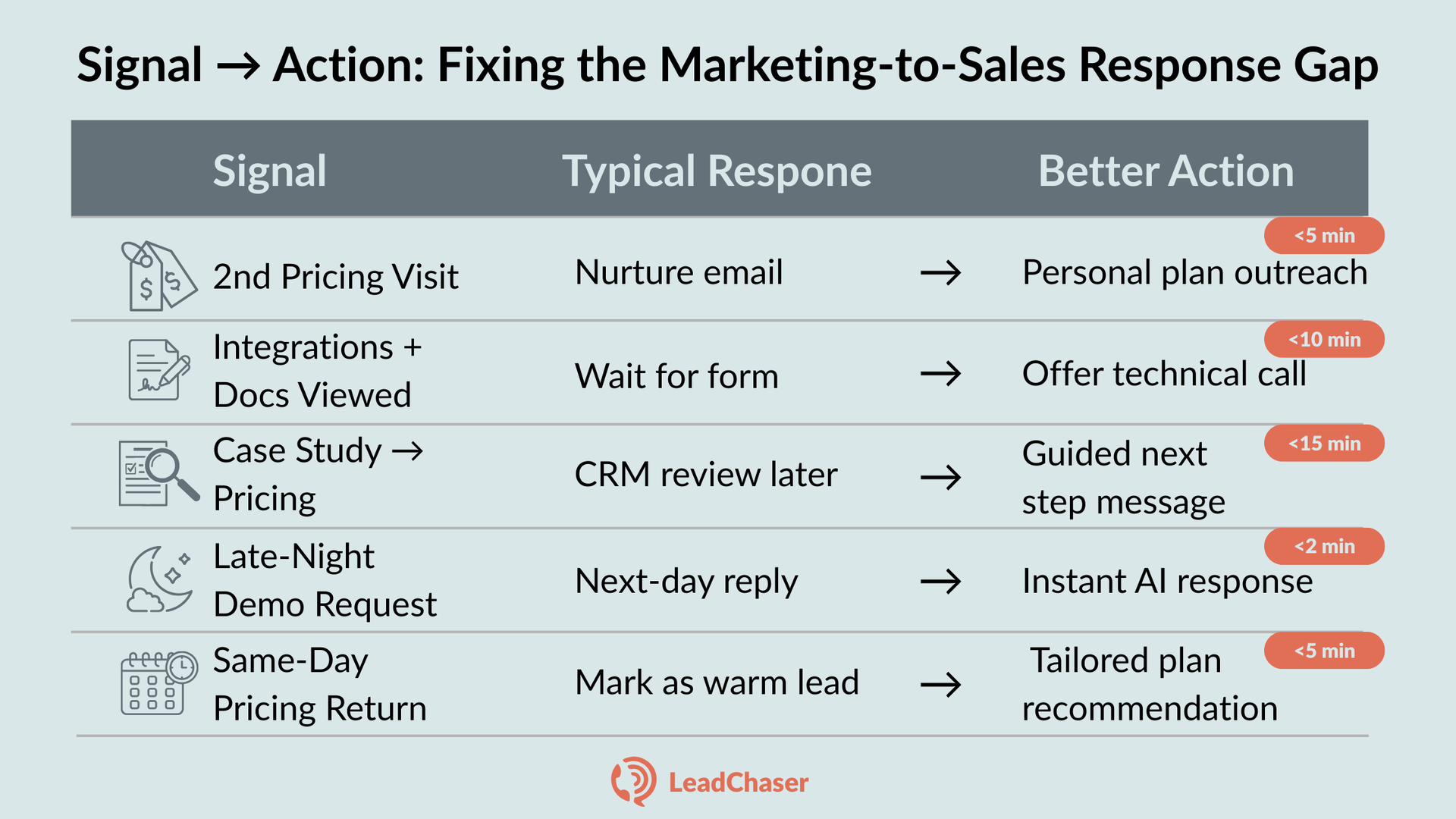
Intent SignalWhat Most Teams DoWhat Should HappenTime to RespondSecond pricing page visit in 7 daysAdd to email nurture sequenceTrigger personalized plan-fit outreach + ROI model offerUnder 5 minutesIntegrations + documentation in the same sessionNo action until the form is submittedSend "works with your stack" message + offer Sales Engineering callUnder 10 minutesContent stack: case study → product tour → ROI calculator → pricingLog in to CRM for weekly reviewSend "choose your path" follow-up (ROI / implementation/ security)Under 15 minutesLate-night demo requestQueue for next-morning follow-upInstant AI acknowledgment + scheduling link + 2 qualifying questionsUnder 2 minutesThird-party intent spike on competitor + category topicsIgnore unless they come inboundABM ad sequence + personalized landing + direct outreach at thresholdUnder 24 hoursSecurity page revisited + potential link sharingTreat as general interestAuto-send security packet + offer security office hoursUnder 10 minutesSame-day return to pricing pageMark as a warm leadImmediate human-calibrated outreach with a specific plan recommendationUnder 5 minutes
What Does an Effective Intent-to-Outreach System Actually Look Like?
How Do You Build a Trigger-Response Framework That Captures These Signals?
You build it around behaviors, not demographics. Demographic data tells you who might buy. Behavioral data tells you who is buying right now.
The following checklist represents the minimum viable infrastructure for a team that wants to act on intent signals before competitors do.LeadChaseris built to support each of these steps with real-time signal detection, instant calling, automated messages, and configurable response hours.
** 8-Step Intent Response Infrastructure Checklist:**
**1. Instrument your highest-intent pages first.**Pricing, integrations, security, implementation, and comparison pages should have session-depth tracking, scroll mapping, and return-visit detection configured before any other analytics investment.
**2. Define scoring thresholds for each signal type.**A single pricing page visit scores differently than a second visit within seven days. A content stack that includes an ROI calculator and pricing in the same session scores higher than a case study alone. Codify these thresholds explicitly so your behavior analytic system has clear escalation rules.
**3. Connect your intent data co-op to your CRM in real time.**Third-party behavioral signals should be appended to account records as they are generated, not in nightly batch syncs. A 12-hour delay on a high-intent account-level spike can often be the difference between being first and fourth.
**4. Build channel-specific response workflows for each trigger type.**A late-night demo request needs a different response than a daytime pricing page revisit. A security page repeat visit needs a different asset than a product tour completion. One generic follow-up template cannot effectively serve all of these triggers.
**5. Configure AI lead generation agents to handle off-hours acknowledgment and qualification.**The agent's job at 11 PM is not to close the deal. It is to acknowledge immediately, capture two or three qualifying questions, and set a human up for a prepared conversation the next morning. That is a narrow but critical function.
**6. Audit your automated messages for contextual relevance quarterly.**Automated messagesthat were accurate for your product positioning six months ago may now be misaligned. Buyer objections, competitive positioning, and pricing structures change frequently, and your automated messages must adapt accordingly to remain effective.
**7. Integrate customer retention strategies into your trigger-response framework.**Recognizing signals from existing clients who may be evaluating alternatives is just as important as identifying new leads. Implementing customer retention strategies that leverage the same behavior analytic models can help maintain engagement and prevent churn.
**8. Train your team on the importance of lead nurturing and real-time response.**Even the most sophisticated AI lead generation and automated messages systems require human oversight and intervention. Ensuring that your team understands the value of timely, relevant outreach is crucial for maximizing the effectiveness of your intent-to-outreach system.
FAQ
Q1) What are the best tools for automated outreach timing to maximize engagement?
The best tools for automated messages timing combine real-time signal detection with configurable response windows. Platforms likeLeadChaserandHubSpot Marketing Automationallow teams to set up triggers based on specific behaviors, such as pricing page revisits or late-night demo requests, and deliver automated messages within minutes. These tools also enable A/B testing of message timing to determine the optimal windows for engagement. For example, research fromZendesk's CX Trends 2026shows that responsiveness within the first five minutes can increase conversion rates by up to 30%. Additionally, integrating behavior analytic tools like6sensecan further refine outreach timing by identifying patterns in buyer behavior that indicate the best moments for engagement.
**Q2) What are the best AI tools for intent data analysis that improve lead scoring? **
The top-rated AI lead generation tools for intent data analysis includeBombora,6sense, andLeadfeeder. These platforms specialize in aggregating and analyzing third-party intent data, enabling teams to identify accounts actively researching their category or competitors. For instance,Bomborawas recognized as a Leader in Forrester's B2B Intent Data Providers Wave for Q1 2025, highlighting its ability to provide enterprise-grade intent signals. These tools integrate with CRM systems to append intent data to account records, enabling more accurate lead scoring and prioritization. Additionally, behavior analytic platforms likeGainsightcan further enhance intent data analysis by tracking in-depth behavioral patterns across multiple touchpoints, providing a comprehensive view of buyer readiness.
Q3) What are the top-rated AI tools for measuring stakeholder engagement in buying groups?
Measuring stakeholder engagement in buying groups requires tools that can track and analyze interactions across multiple channels and team members. Top-rated AI lead generation tools for this purpose include6sense,Gong, andChorus.ai. These platforms use behavior analytic models to identify patterns in engagement, such as repeat visits to technical pages or content stacking, which indicate a buying group in motion. For example,6sense's 2025 B2B Marketing Attribution Benchmarkfound that typical B2B buying teams generate over 4,000 interactions across their journey, making it essential to have tools that can aggregate and interpret these signals. Additionally,GongandChorus.aiprovide conversation intelligence, analyzing sales calls and meetings to identify key stakeholders and their level of engagement, further enhancing the ability to measure and respond to buying group dynamics.
Q4) How can AI tools enhance the effectiveness of lead nurturing campaigns?
AI lead generation tools can significantly enhance lead nurturing campaigns by enabling real-time, contextually relevant outreach. Platforms likeHubSpot Marketing Automation,Marketo, andLeadChaseruse behavior analytic models to detect high-intent signals, such as content stacking or pricing page revisits, and trigger automated messages tailored to the observed behaviors. For instance, if a buyer consumes a case study, product tour, and ROI calculator in a single session, the AI can send a "choose your path" follow-up that addresses their specific interests, such as ROI modeling or implementation timelines. Research from6sense's 2025 Attribution Benchmarkshows that personalized, behavior-driven lead nurturing campaigns can increase conversion rates by up to 40%. Additionally, AI tools can continuously optimize automated messages based on engagement data, ensuring that each interaction is as effective as possible.
Q5) What are the key features to look for in AI tools for customer retention strategies?
When selecting AI lead generation tools for customer retention strategies, key features to look for include real-time signal detection, predictive analytics, and CRM system integration. Tools likeGainsight,Totango, andChurnZerospecialize in identifying at-risk customers by tracking behavioral signals, such as decreased engagement or repeat visits to pricing pages, which may indicate a client is evaluating alternatives. These platforms use behavior analytic models to predict churn risk and trigger automated messages or interventions to re-engage customers. For example,Gainsightprovides health scores that quantify customer engagement and satisfaction, allowing teams to proactively address potential issues. Additionally, integrating these tools with CRM systems ensures that all customer interactions are tracked and analyzed, providing a comprehensive view of customer health and enabling more effective customer retention strategies.
Works Cited
6sense. "2025 B2B Buyer Experience Report."6sense, 2025,6sense.com/science-of-b2b/buyer-experience-report-2025/.
6sense. "2025 B2B Marketing Attribution and Contribution Benchmark."6sense, 2025,6sense.com/science-of-b2b/2025-b2b-marketing-attribution-and-contribution-benchmark/
Bombora. "Bombora Recognized As a Leader Among B2B Intent Data Providers by Independent Research Firm."Business Wire, 26 Feb. 2025,businesswire.com/news/home/20250226500457/en/Bombora-Recognized-As-a-Leader-Among-B2B-Intent-Data-Providers-by-Independent-Research-Firm.
McKinsey & Company. "Five Fundamental Truths: How B2B Winners Keep Growing."McKinsey & Company, 2024,mckinsey.com/capabilities/growth-marketing-and-sales/our-insights/five-fundamental-truths-how-b2b-winners-keep-growing.
National Institute of Standards and Technology. "Artificial Intelligence Risk Management Framework: Generative Artificial Intelligence."NIST, 2024,nist.gov/publications/artificial-intelligence-risk-management-framework-generative-artificial-intelligence.
Salesforce. "State of Sales Report: Announcement 2026."Salesforce, 2025,salesforce.com/news/stories/state-of-sales-report-announcement-2026/.
Stanford University. "Foundation Model Transparency Index: AI Companies Information."Stanford News, 2025,news.stanford.edu/stories/2025/12/foundation-model-transparency-index-ai-companies-information.
Twilio. "State of Personalization Report."Twilio, 2024,twilio.com/en-us/report/state-of-personalization-report.
Zendesk. "Contextual Intelligence Becomes the New Standard for Exceptional Customer Experience in 2026."Zendesk, 2025,zendesk.com/newsroom/press-releases/contextual-intelligence-becomes-the-new-standard-for-exceptional-customer-experience-in-2026/.