
The marketing-to-sales handoff is where momentum often dies. This blog explains how AI-based routing, SLA enforcement, and real-time alerts tighten alignment, increase MQL-to-SQL conversion, and reduce internal friction.
TL;DR
- According to aGartner survey fielded November–December 2024, 49% of Chief Sales Officers report their organization's definition of a qualified lead differs greatly from marketing's definition, meaning handoffs are structurally misaligned before a single lead is routed.
- Forrester's October 2024 B2B alignment researchreveals a dangerous perception gap: 82% of C-level leaders believe sales and marketing are aligned, while 65% of practitioners say they are not.
- Ebsta and Pavilion's 2024 B2B Sales Benchmarksshow that more than 7 days of pipeline inactivity reduces win rates by 65%, making real-time escalation a financial imperative rather than a process nicety.
- 6sense's 2025 B2B Buyer Experience Reportconfirms that buyers are now entering conversations 6–7 weeks earlier in the purchase journey than in 2024, compressing the window between the first intent signal and the required response.
- Salesforce's AI agents case study (2026)demonstrates that automated outreach to previously untouched leads produced 3,200 opportunities from 130,000 contacts in just four months, reframing dropped leads as an engineering problem with an engineering solution.
Introduction: Why the Handoff Is Where Your Pipeline Goes to Die
You have invested in content, campaigns, paid media, SEO, and intent data. Your lead generation engine is producing volume. And yet, somewhere between the moment a prospect fills out a form and the moment a qualified sales conversation begins, something goes wrong.
Conversion rates disappoint. Reps complain about lead quality. Marketing insists the leads were perfectly qualified. Neither side is lying. Both sides operate within a broken system.
The marketing-to-sales handoff is not a communication problem. It is a systems architecture problem, one that lives in the dead space between your marketing automation platform, your CRM, your routing logic, and your reps' calendars. When lead generation produces real buyer intent, but the mechanics of transferring that intent to the right human at the right moment are unreliable, every upstream investment is partially wasted.
This article is written for revenue operators, GTM leads, and sales and marketing professionals who have moved past debating whether alignment matters and are ready to discuss exactly how to instrument, enforce, and automate a handoff that converts. We will cover definitional alignment, SLA architecture, AI in sales workflows, and the specific metrics that separate high-performing handoff systems from organizations still relying on shared spreadsheets and good intentions.
Why Do Sales and Marketing Disagree on What "Qualified" Actually Means?
The disagreement is not a personality conflict, it is a structural artifact of how most B2B organizations were built. Marketing measures success at the top and middle of sales funnels; sales measures success at the bottom. Without a shared, contractual definition of qualification, each team optimizes for its own metric, and the handoff becomes a blame boundary rather than a conversion point.
Gartner's November–December 2024 survey of Chief Sales Officersfound that 49% of CSOs reported their sales organization's definition of a qualified lead differs greatly from marketing's. That is not a minority edge case. When nearly half of the revenue-side leaders in an organization operate on a fundamentally different qualification standard than their marketing counterparts, no amount of improved lead generation will fix downstream conversion rates.
What Does "Qualified" Need to Mean to Both Teams?
A useful shared definition requires three discrete objects, not one. Each object needs explicit criteria that both teams have agreed to in writing, ideally embedded in the CRM as required fields rather than documented in a PDF that nobody opens.
** MQL (Marketing-Qualified Lead):**A prospect who meets your Ideal Customer Profile criteria, firmographic, technographic, or role-based, and has crossed a behavioral intent threshold defined in your scoring model. The MQL designation is owned by marketing and should trigger a routing event, not a Slack message.
** SAL (Sales-Accepted Lead):**A prospect that a sales representative has reviewed and confirmed meets the threshold for active pursuit right now, not "someday" or "maybe next quarter." The SAL stage exists specifically to create an accountability checkpoint where sales takes formal ownership. If a rep rejects an SAL, the rejection must include a coded reason that feeds back into the scoring model. Without this feedback loop, your sales funnels cannot improve.
** SQL / Meeting-Worthy Lead:**A prospect with a confirmed problem or trigger, verified decision-making authority or access, and a scheduled next step. The SQL is not a score; it is a confirmed behavioral signal. This is the stage where AI in sales can contribute most directly by surfacing intent signals, verifying contact data, and flagging the optimal meeting time based on prior engagement patterns.
TheForrester alignment research from October 2024adds a layer of urgency here: while 82% of C-suite leaders believe their sales and marketing teams are aligned, 65% of the practitioners doing the actual work report the opposite. This gap means that even if your VP of Marketing and your VP of Sales shake hands over a shared dashboard, the reps processing leads and the campaign managers generating them may be operating in fundamentally different frameworks.
Is Your Handoff Architecture Built for Speed, or Just Built for Documentation?
Most handoff architectures were not designed; they accumulated over time. A form connects to a marketing automation platform. Scoring rules get added over time. Someone builds a Zap to push leads into the CRM. A rep notices leads are going to the wrong territory and adds a manual filter. Three years later, the "system" is a patchwork of conditional logic, stale routing rules, and CRM fields that nobody has audited since the last re-org. That is not an automated workflow. It is a liability disguised as a process.
An automated workflow that reliably converts MQLs to meetings requires three engineering decisions, not three software subscriptions. Those decisions are: when does the handoff trigger, who receives it, and what happens if nobody acts.
How Do You Replace a "Speed-to-Lead" Mindset With a "Speed-to-Conversation" Mindset?
Speed to conversation is the correct metric because it measures what actually moves the deal, not what satisfies an internal SLA checkbox. TheChili Piper "marketing last mile" framing (April 2024)persuasively argues that the final handoff moment is where most conversion loss occurs, not in the quality of the campaign or the accuracy of the scoring model, but in the mechanics of getting from form fill to the first meaningful human interaction.
6sense's 2025 B2B Buyer Experience Reportquantifies why this has become more urgent: the point of first contact between a buyer and a seller has shifted from approximately 69% of the way through the buying journey in 2024 to approximately 61% in 2025, roughly 6 to 7 weeks earlier. Buyers are reaching out sooner, which means they are also reaching out with less certainty, more questions, and higher sensitivity to response quality. A fast, context-free acknowledgment is no longer enough. The rep who picks up the lead needs to arrive in the conversation with the buyer's intent history, the account's firmographic profile, and a proposed next step already structured.
This is exactly where AI in sales stops being a theoretical benefit and starts producing measurable outcomes.LinkedIn Sales Solutions' 2025 ROI of AI report, based on an Ipsos survey of 1,250 sales professionals, found that 56% of sales professionals use AI daily, sellers who improved response rates with AI saw an average lift of 28%, and 69% reported cutting their sales cycle by approximately one week through AI-assisted workflows. The outcome is not better emails, it is faster, more relevant first conversations.
What Does a RevOps-Owned Handoff System Actually Look Like in Practice?
RevOps ownership is the structural answer to the coordination failure between marketing operations and sales operations. When the handoff is nobody's job in particular, it belongs to everyone in theory and nobody in practice.Alexander Group's 2024 RevOps research, drawing on a survey of more than 130 revenue executives, found that 47% of organizations now have cross-functional RevOps teams spanning Marketing, Sales, and Services, and 66% planned to increase RevOps headcount in 2024. The handoff redesign is not a soft alignment initiative; it is a RevOps infrastructure build.
How Should SLAs Be Encoded Into Your Routing System Rather Than Stored in a Document?
SLA-as-a-PDF fails because it cannot escalate, re-route, or measure itself. SLA-as-code, meaning programmatic rules embedded in your routing and notification infrastructure, behaves like a reliability system rather than a policy document. This is the engineering reframe that separates modern GTM operators from organizations still running quarterly "alignment offsites."
The mechanics of an enforceable SLA system look like this in practice:
** Time-to-first-action thresholds by lead type:**Demo or pricing intent should trigger a 5-minute response SLA. Webinar registrants or hand-raisers warrant a 30-minute threshold. Content-only interactions can be handled on a same-day basis. These are not aspirational goals; they are routing conditions enforced by the automated workflow.
** Escalation chains for missed SLAs:**If the assigned rep does not log a first action within the defined window, the lead re-routes to the next available qualified responder. If the second window closes, the system alerts the manager and assigns the lead to a dedicated inbound response team. The escalation is automatic, logged, and reportable.
** Capacity-aware routing:**A hot lead routed to a rep who is in back-to-back meetings is effectively an unrouted lead. Capacity-aware routing systems check real-time rep availability, calendar blocks, active call status, and current pipeline load before assigning. This is one of the specific places where AI in sales delivers operational value that has nothing to do with content generation.
The financial case for this precision is made cleanly byEbsta and Pavilion's 2024 B2B Sales Benchmarks: leads with more than 7 days of inactivity and no scheduled future activity see win rates drop by 65%. A weekly lead aging report cannot prevent that outcome. Only real-time escalation can.
How Does AI in Sales Change the Mechanics of Lead Routing and Handoff?
AI in sales has moved beyond being primarily useful for writing outreach copy. The operational value in 2025 is concentrated in workflow control, routing decisions, follow-up triggering, meeting scheduling, CRM hygiene, and alert generation. These are the functions that live inside the handoff and that determine whether a lead converts or stalls.
Salesforce's 2024 State of Sales researchfound that sales representatives spend 70% of their time on non-selling tasks, and that teams using AI were significantly more likely to report revenue growth, 83% of AI-using teams versus 66% of non-AI teams. The implication for the handoff is direct: if reps are spending most of their time on administrative coordination, the handoff process itself is a primary source of non-selling drag. Automating the routing, enrichment, and notification layers of the handoff returns selling time to reps while improving consistency.
TheSalesforce AI agents case study from 2026makes the scale argument: over four months, AI agents contacted 130,000 previously untouched leads and generated 3,200 opportunities. Those were not bad leads; they were leads that had fallen through the floor of an under-resourced handoff system. The automated workflow did not replace human selling; it recovered value that the human system had structurally failed to capture.
What Real-Time Alerts Actually Change Behavior, and Which Ones Just Create Noise?
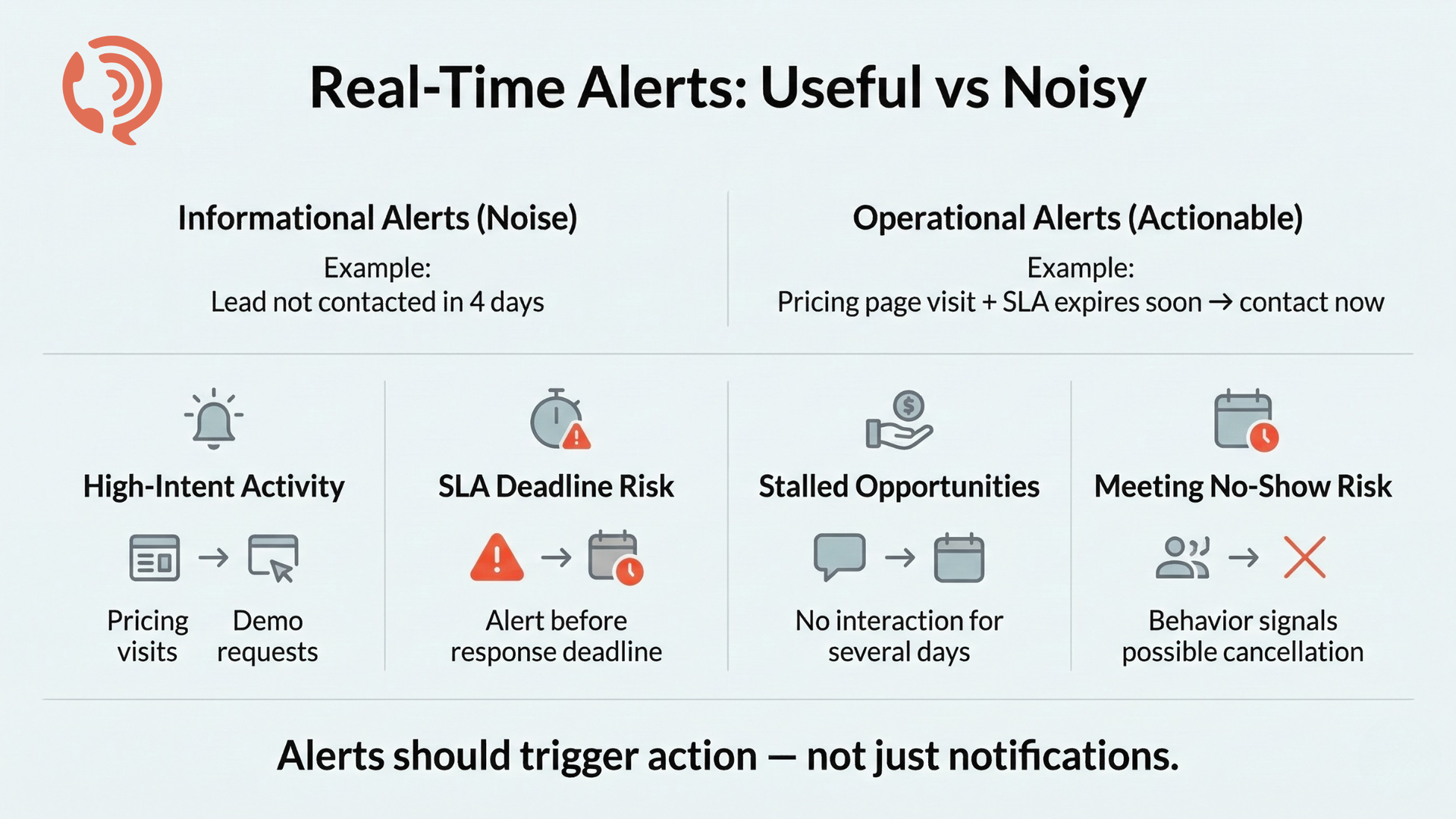
The answer depends entirely on whether the alert triggers a specific, feasible action within a defined window. Alerts that say "this lead has not been contacted in 4 days" are informational. Alerts that say "this lead visited your pricing page 3 times in the last 2 hours and your SLA expires in 18 minutes, here is the rep's calendar link and the lead's full intent history" are operational.
The four alert categories worth building into your system are:
- **High-intent moments:**pricing page visits, demo request submissions, competitor comparison page views, and return visits within a compressed timeframe.
- **SLA breach warnings:**alerts triggered before the SLA window closes, not after, giving the rep or manager time to act rather than just documenting the failure.
- **Stalled conversations:**flagging active opportunities where the last meaningful interaction crossed a defined threshold, based on the Ebsta data showing the 7-day inactivity cliff.
- **Meeting no-show risk:**using prior engagement patterns and scheduling behavior to flag prospects with elevated cancellation probability before the meeting, not after.
Each of these alert categories maps directly to a decision a human needs to make. That is the standard for a useful alert inside an automated workflow.
Comparison: Reactive Handoff Systems vs. Engineered Handoff Systems
DimensionReactive Handoff SystemEngineered Handoff SystemLead Qualification DefinitionInformal or undocumented; varies by repContractual MQL/SAL/SQL definitions embedded in CRM fieldsRouting LogicManual assignment or round-robinCapacity-aware, intent-weighted, territory-verified routingSLA EnforcementPDF documentation reviewed quarterlyProgrammatic escalation chains with real-time triggersResponse SpeedBest effort; averages 24+ hoursTime-boxed by lead type; 5 min to same-day based on intentAI in Sales RoleContent assist and email draftingRouting, enrichment, scheduling, CRM hygiene, alert generationAlert SystemWeekly pipeline aging reportsReal-time behavioral alerts tied to specific action windowsHandoff OwnershipDisputed between Marketing Ops and Sales OpsOwned by cross-functional RevOps with defined accountabilityFeedback LoopAnecdotal; post-quarter retrospectivesCoded SAL rejection reasons feeding back into the scoring modelKey MetricMQL volumeTime-to-conversation; MQL-to-SQL conversion rateFailure ModeLeads fall silently; nobody notices until QBRBreaches generate incidents; escalation is automatic and logged
How Do You Build a Handoff System That Actually Works? An 8-Step Operational Checklist
The following checklist is designed for revenue operators who need to move from diagnosis to implementation. Each step includes a specific action and the system it affects. The sequence matters: definitional work must precede technical configuration, and measurement infrastructure must be in place before optimization begins.
**1. Audit your current qualification definitions.**Convene a structured session with Marketing Ops, Sales Ops, and at least two frontline reps. Document each team's current working definition of MQL, SAL, and SQL. Identify every point of disagreement. Use theGartner 49% misalignment findingas a forcing function to take the disagreement seriously rather than papering over it. This foundational step ensures that your sales funnels are built on a shared understanding of what constitutes a qualified lead.
**2. Write contractual definitions into your CRM as required fields.**Every MQL handoff should populate a minimum field set: ICP match score, intent signals triggered, source campaign, firmographic tier, and the specific threshold that qualified the record. Definitions that exist only in documents are not definitions; they are suggestions. This step is critical for ensuring that your lead generation efforts are aligned with sales expectations from the outset.
**3. Map the current handoff sequence step-by-step.**Document every system touchpoint between form fill and first rep action: form submission, enrichment API call, scoring model evaluation, CRM record creation, routing rule execution, notification delivery, rep acknowledgment, and first logged activity. Identify every gap, delay, and manual step in the current automated workflow. This audit will reveal inefficiencies that are costing your organization valuable opportunities.
**4. Set time-to-first-action SLAs by lead type and enforce them programmatically.**Do not create a policy document. Create routing logic and escalation rules inside your CRM or GTM orchestration tool. Assign numeric thresholds, 5 minutes for demo intent, 30 minutes for hand-raisers, same-day for content-only, and build the escalation chain that fires when those thresholds are breached. This step ensures that your sales and marketing teams are operating under a unified set of expectations for response times.
**5. Implement capacity-aware routing before your next campaign launch.**Connect your routing system to rep calendar availability, active pipeline load, and timezone coverage. Route high-intent leads from lead generation campaigns to the fastest qualified available responder, not to the alphabetically next rep on a round-robin list. This step leverages AI in sales to optimize resource allocation and improve conversion rates.
**6. Deploy the four real-time alert categories into your sales engagement platform.**Configure alerts for high-intent moments, SLA breach warnings, stalled conversations past the 7-day threshold, and meeting no-show risk signals. Each alert must include the lead's intent history, the required action, and the available window, not just a notification that something happened. This step ensures that your automated workflow is proactive rather than reactive.
**7. Build a coded SAL rejection taxonomy in your CRM.**Every rejected SAL must carry a reason code: wrong persona, outside territory, premature in cycle, wrong product fit, duplicate record. Aggregate these codes monthly and use them to refine your lead generation targeting and scoring model. This feedback loop is essential for continuously improving the quality of leads entering your sales funnels.
**8. Assign RevOps ownership of the handoff system with a defined accountability structure.**Designate a specific individual or team responsible for handoff SLA performance, routing accuracy, and the monthly review of rejection reason data. Measure them on time-to-conversation and MQL-to-SQL conversion rate. Without owned accountability, the system will drift back to reactive behavior within 90 days. This step ensures that your sales and marketing alignment efforts are sustained over time.
What Governance Guardrails Should You Put Around AI-Powered Routing and Scoring?
AI in sales routing and scoring systems are decision systems with legal and reputational exposure, not just productivity tools. TheFTC's January 2025 guidance on AI risk and consumer harmis explicit: there is no "AI exemption" from consumer protection law, and regulators are actively scrutinizing AI systems for privacy violations, deceptive claims, and discriminatory outcomes. If your lead scoring model produces systematic differences in treatment of prospects based on protected characteristics, even inadvertently, through proxy variables, that is a legal exposure.
TheNIST AI Risk Management Framework Playbook (updated February 2025)provides a practical governance structure that translates well to lead routing and scoring systems. The key operational elements are: maintaining a human override capability at every routing decision point, preserving audit logs of routing decisions and the inputs that drove them, conducting periodic bias audits of scoring outputs, and documenting the model's intended scope so that edge cases are handled by human judgment rather than extrapolation.
For sales and marketing teams, this translates to:
**Human-in-the-loop routing:**Every AI-driven routing decision must be reviewable and reversible by a human operator within a defined window. This ensures that edge cases, such as leads from unexpected industries or roles, are handled appropriately rather than being misrouted by an overly rigid model.
**Audit trails for all routing decisions:**Maintain a complete log of every routing decision, including the intent signals, scoring inputs, and rep availability data that informed the decision. This log should be retained for at least 12 months and made available for regulatory or internal audits. This is particularly important for organizations that rely heavily on lead generation campaigns to fill their sales funnels.
**Bias audits on scoring models:**Conduct quarterly audits of your lead scoring model to ensure that it is not producing systematically different outcomes for protected classes. Use tools like disparate impact analysis to identify and correct unintended biases. This step is critical for ensuring that your AI in sales systems is fair and compliant with anti-discrimination laws.
**Clear documentation of model scope:**Define the intended use cases and limitations of your AI-powered routing and scoring systems. Document the types of leads the model is designed to handle and the types of leads that should be escalated to human judgment. This documentation should be reviewed and updated whenever the model is retrained or modified. This ensures that your automated workflow remains aligned with your business objectives and legal requirements.
FAQ
Q1) What are the best tools to optimize MQL to SQL conversion rates?
Optimizing MQL-to-SQL conversion rates requires a combination of tools to enhance lead qualification, routing, and engagement. The best tools for this purpose include:
**Marketing Automation Platforms:**Tools like HubSpot, Marketo, and Pardot help score leads based on behavior and demographics, ensuring that only high-quality leads are passed to sales. These platforms are essential for managing the top of your sales funnels and ensuring your lead generation efforts align with sales expectations.
**CRM Systems:**Salesforce, Microsoft Dynamics, and Zoho CRM provide the infrastructure for tracking lead progression, managing SLAs, and ensuring that leads are routed to the right reps. These systems are critical for maintaining visibility into your sales and marketing alignment efforts.
**AI-Powered Routing Tools:**Platforms like LeanData, Chili Piper, and Outreach use AI in sales to route leads based on intent, capacity, and territory. These tools ensure that leads are directed to the most appropriate rep in real time, reducing the risk of leads falling through the cracks in your automated workflow.
**Sales Engagement Platforms:**Tools like SalesLoft, Groove, and Yesware help reps engage with leads more effectively by providing templates, sequencing, and analytics. These platforms are particularly useful for ensuring that leads are nurtured appropriately as they move through your sales funnels.
**Intent Data Providers:**Companies such as 6sense, Bombora, and Demandbase provide intent data to prioritize leads based on their likelihood to buy. This data is invaluable for ensuring that your lead generation efforts are focused on the most promising prospects.
By integrating these tools into a cohesive automated workflow, organizations can significantly improve their MQL-to-SQL conversion rates and ensure that their sales and marketing teams work in lockstep.
Q2) What is the top-rated AI lead routing software for sales teams?
The top-rated AI in sales lead routing software for sales teams includes:
**LeanData:**A leading AI-powered lead routing and matching platform that integrates seamlessly with Salesforce. It uses machine learning to route leads based on intent, capacity, and territory, ensuring that leads are directed to the most appropriate rep in real time. LeanData is particularly effective for organizations with complex routing rules and large volumes of leads.
**Chili Piper:**Chili Piper is a real-time scheduling and routing tool that uses AI to connect leads with the right rep instantly. It integrates with marketing automation platforms and CRMs to ensure that leads are routed and scheduled for meetings without delay. Chili Piper is ideal for organizations that prioritize speed-to-conversation in their sales funnels.
**Outreach:**A sales engagement platform that uses AI to optimize lead routing, sequencing, and engagement. It provides reps with actionable insights and automates repetitive tasks, allowing them to focus on high-value activities. Outreach is particularly useful for organizations that rely on outbound lead generation campaigns.
**Groove:**A sales engagement platform that uses AI to route leads based on intent, capacity, and rep performance. It integrates with Salesforce to provide a seamless handoff between marketing and sales. Groove is ideal for organizations that want to ensure that their sales and marketing teams are aligned and working efficiently.
**SalesLoft:**A sales engagement platform that uses AI to optimize lead routing, sequencing, and engagement. It provides reps with real-time insights and automates repetitive tasks, allowing them to focus on building relationships with prospects. SalesLoft is particularly effective for organizations looking to improve their MQL-to-SQL conversion rates.
These tools leverage AI in sales to ensure that leads are routed to the right rep at the right time, improving conversion rates and reducing the risk of leads falling through the cracks in your automated workflow.
Q3) What are the best CRM solutions for integrating marketing and sales efforts?
The best CRM solutions for integrating sales and marketing efforts include:
**Salesforce:**Salesforce is the most widely used CRM platform and offers robust integrations with marketing automation tools like Pardot, Marketo, and HubSpot. It provides a unified view of leads and customers, ensuring that both sales and marketing teams have access to the same data. Salesforce is ideal for organizations seeking to create a seamless handoff between marketing and sales within their sales funnels.
**HubSpot CRM:**A user-friendly platform that integrates seamlessly with HubSpot's marketing automation tools. It provides a unified view of leads and customers, ensuring that both sales and marketing teams are aligned. HubSpot CRM is particularly effective for organizations seeking to improve lead generation and ensure leads are nurtured appropriately.
**Microsoft Dynamics 365:**A comprehensive CRM platform that integrates with Microsoft's suite of productivity tools, including LinkedIn Sales Navigator. It provides a unified view of leads and customers, ensuring that both sales and marketing teams have access to the same data. Dynamics 365 is ideal for organizations that want to leverage AI in sales to optimize their automated workflow.
**Zoho CRM:**A cost-effective platform that integrates with Zoho's suite of marketing automation tools. It provides a unified view of leads and customers, ensuring that both sales and marketing teams are aligned. Zoho CRM is particularly effective for small and mid-sized organizations looking to improve their MQL-to-SQL conversion rates.
**Pipedrive:**Pipedrive is a sales-focused CRM platform that integrates with marketing automation tools like Mailchimp and ActiveCampaign. It provides a simple, intuitive interface for managing leads and deals, ensuring that both sales and marketing teams are aligned. Pipedrive is ideal for organizations looking to streamline their sales funnels and improve lead generation.
These CRM solutions provide the infrastructure to integrate sales and marketing efforts, ensuring that leads are nurtured appropriately and that both teams are aligned on the same goals.
Q4) How can AI improve the efficiency of sales funnels?
AI in sales can significantly improve sales funnel efficiency by automating repetitive tasks, optimizing routing decisions, and providing reps with actionable insights. Here are some of the ways AI can enhance your sales funnels:
**Lead Scoring:**AI-powered lead scoring models analyze behavioral and demographic data to prioritize leads based on their likelihood to convert. This ensures reps focus their efforts on the most promising prospects, improving the efficiency of your lead generation.
**Routing Optimization:**AI-driven routing systems use real-time data to direct leads to the most appropriate rep based on intent, capacity, and territory. This reduces the risk of leads falling through the cracks and ensures reps focus on the highest-value opportunities.
**Automated Outreach:**AI-powered sales engagement platforms automate repetitive tasks like email sequencing and follow-ups, allowing reps to focus on building relationships with prospects. This improves the efficiency of your automated workflow and ensures that leads are nurtured appropriately.
**Predictive Analytics:**AI-driven predictive analytics tools analyze historical data to identify patterns and trends that can inform sales strategies. This helps organizations optimize their sales funnels and improve their MQL-to-SQL conversion rates.
**CRM Hygiene:**AI-powered tools can automatically update and enrich CRM records, ensuring that reps have access to accurate, up-to-date information. This improves the efficiency of your sales and marketing efforts and ensures that both teams use the same data.
By leveraging AI in sales, organizations can significantly improve the efficiency of their sales funnels, reduce the risk of leads falling through the cracks, and ensure reps focus their efforts on the most promising opportunities.
Q5) What are the key metrics to track for MQL to SQL conversion success?
Tracking the right metrics is essential for optimizing MQL-to-SQL conversion rates and ensuring your sales and marketing teams are aligned. Here are the key metrics to monitor:
MQL to SQL Conversion Rate:This metric measures the percentage of MQLs that are accepted by sales and converted to SQLs. A high conversion rate indicates that yourlead generationefforts are producing high-quality leads that are aligned with sales expectations.
**Time-to-Conversation:**This metric measures the average time from MQL qualification to a meaningful conversation with a sales rep. A shorter time-to-conversation indicates that your automated workflow is efficient and that leads are being routed and engaged quickly.
**SLA Compliance Rate:**This metric measures the percentage of leads that are contacted within the defined SLA window. A high compliance rate indicates that your routing and escalation systems are working effectively and that reps are adhering to the agreed-upon response times.
**Lead Aging:**This metric measures the average age of leads in your pipeline. A high lead aging metric indicates that leads are stagnating in your sales funnels, which can negatively impact conversion rates. Monitoring this metric can help you identify bottlenecks in your automated workflow and take corrective action.
**SAL Rejection Rate:**This metric measures the percentage of SALs that are rejected by sales reps. A high rejection rate may indicate that your lead generation efforts are producing low-quality leads or that your qualification criteria are misaligned with sales expectations. Monitoring this metric can help you refine your scoring model and improve the quality of leads entering your sales funnels.
**Opportunity Win Rate:**This metric measures the percentage of SQLs that are converted to closed-won deals. A high win rate indicates that your sales and marketing teams are aligned and that your AI in sales systems is effectively supporting the sales process.
By tracking these metrics, organizations can identify areas for improvement in their sales funnels, optimize their automated workflows, and ensure their sales and marketing teams work in lockstep to drive revenue growth.
Works Cited
Alexander Group. "RevOps Survey Briefing."Alexander Group, 2024,https://digitalcontent.alexandergroup.com/revops-survey-briefing/.
Chili Piper. "Speed-to-Lead: The Marketing Last Mile Problem."Chili Piper Blog, April 2024,https://www.chilipiper.com/post/speed-to-lead-the-marketing-last-mile-problem.
Ebsta and Pavilion. "2024 B2B Sales Benchmarks."Ebsta, 2024,https://www.ebsta.com/ebsta-pavilion-b2b-sales-benchmarks-2024/.
Federal Trade Commission. "AI Risk and Consumer Harm."FTC, January 2025,https://www.ftc.gov/policy/advocacy-research/tech-at-ftc/2025/01/ai-risk-consumer-harm.
Forrester. "The Truth About B2B Sales and Marketing Alignment."Forrester Blog, October 2024,https://www.forrester.com/blogs/the-truth-about-b2b-sales-and-marketing-alignment/.
Gartner. "Gartner Survey Reveals Less Than Half of CSOs Report Their Organization Met Several 2024 Strategic Goals."Gartner Newsroom, 21 May 2025,https://www.gartner.com/en/newsroom/press-releases/2025-05-21-gartner-survey-reveals-less-than-half-of-csos-report-their-organization-met-several-2024-strategic-goals.
LinkedIn Sales Solutions. "ROI of AI Report 2025."LinkedIn Business, 2025,https://business.linkedin.com/content/dam/me/business/en-us/sales-solutions/resources/pdfs/linkedin-sales-navigator-roi-of-ai-report-2025-final.pdf.
National Institute of Standards and Technology. "NIST AI Risk Management Framework Playbook."NIST, February 2025,https://www.nist.gov/itl/ai-risk-management-framework/nist-ai-rmf-playbook.
Salesforce. "AI Agents Case Study."Salesforce News, 2026,https://www.salesforce.com/news/stories/state-of-sales-report-announcement-2026/ai-agents-stats/.
Salesforce. "Sales AI Statistics 2024."Salesforce News, 2024,https://www.salesforce.com/news/stories/sales-ai-statistics-2024/.
6sense. "The 2025 B2B Buyer Experience Report."6sense, 2025,https://6sense.com/science-of-b2b/the-2025-b2b-buyer-experience-report/.